Pull up a chair. Here in Sibyl’s Lab, we’re under the watchful eye of an ancient crone and armed with three decades of card-slinging experience, professional humanities credentials, and zero patience for mystical gatekeeping.
Let me tell you what tarot isn’t.
It isn’t a velvet-draped parlor where you must whisper and tiptoe around sacred mysteries. It isn’t an exclusive club where only the “spiritually advanced” get to play. It isn’t reserved for people who own the right crystals, burn the right incense, or have Mercury in the right house. And it definitely isn’t too precious to help you figure out whether you should text your ex, quit your job, or finally tell your roommate that yes, you can hear them chewing through the walls.
Tarot is a bridge. And bridges, by their very nature, connect two sides.
On one end, you’ve got the mystical, the numinous, the great cosmic whatever-you-want-to-call-it. On the other end, you’ve got Tuesday afternoon, your overflowing inbox, your complicated feelings about your mother-in-law, and that weird smell coming from your car’s air conditioning. Tarot doesn’t ask you to choose between these worlds. It doesn’t demand that you transcend the mundane to access the spiritual. Instead, it says: “Hey, let’s talk about both. Let’s see how they’re connected. Let’s figure out what the Tower card has to say about your crumbling relationship and your crumbling sourdough starter.”
Because here’s the thing: the spiritual and the mundane aren’t separate. They never were. That’s just a story we’ve been told by people who wanted to make wisdom seem rare and inaccessible. The truth is that the divine lives in the details. The sacred shows up in your morning coffee, your commute, your arguments, your grocery lists, your heartbreaks, and your small victories. Tarot simply gives us a language to talk about it all—a symbolic vocabulary that helps us see the patterns, the connections, the meaning woven through the fabric of our beautifully messy lives.
The Serious Business of Not Taking Ourselves Too Seriously
Now, I know what some of you might be thinking. “But isn’t tarot supposed to be serious? Isn’t it ancient wisdom? Shouldn’t we approach it with reverence?”
Sure. And also: no.
Here’s what I’ve learned after years of reading cards: the moment you make something so sacred that you can’t laugh at it, you’ve actually made it smaller. You’ve put it in a box labeled “Serious Spiritual Practice” and placed it on a high shelf where it can’t touch the messy, funny, ridiculous reality of being human.
Real reverence has room for irreverence. Real depth has room for play.
Some of my most profound readings have happened while I was laughing. I’ve pulled the Devil card for someone asking about their obsession with a particular brand of potato chips. I’ve watched the Wheel of Fortune show up for someone trying to decide which Netflix show to binge. I’ve seen the Death card appear when someone asked if they should finally throw out their college textbooks. And you know what? Every single one of those readings was meaningful. Every single one opened up something real.
Because when we allow ourselves to play with tarot, when we bring our whole selves to the table, including our humor and our humanity, we actually go deeper. We stop performing spirituality and start living it. We stop trying to be the kind of person who “should” be reading tarot and become the kind of person who actually benefits from it.
Play isn’t the opposite of serious work. Play is how we access serious work without our defenses getting in the way. When you’re laughing, you’re open. When you’re curious, you’re receptive. When you’re willing to be a little bit silly, you’re also willing to be a little bit vulnerable. And vulnerability is where the magic happens.
No Question Too Big, No Question Too Small
I once had someone apologize before asking their tarot question. “I’m sorry,” they said. “This is probably too trivial.”
They wanted to know which apartment to rent.
Too trivial? This person was about to choose the space where they’d wake up every morning, where they’d cry and laugh and cook and sleep and live a significant chunk of their life. This decision would affect their commute, their budget, their nervous system, their relationships, and their daily sense of peace or chaos. Too trivial?
There is no such thing as a question too small for tarot. And there’s no question too big, either.
Tarot is a tool for mapping life’s messiness and then strategizing the cleanup. It’s a way of taking the tangled ball of yarn that is your situation, whether that situation is “Should I go back to school?” or “Should I buy the blue towels or the green ones?,” and finding the threads. It helps you see what you’re actually dealing with, what patterns are at play, what your options are, and what might happen if you pull on this thread versus that one.
Think of tarot as a really insightful friend who’s good at asking questions. Not the friend who tells you what to do, but the friend who helps you figure out what you think you should do. The friend who says, “Okay, but what are you really asking?” or “What would it mean if you chose that?” or “What are you afraid of here?”
Should you move across the country for a job? Tarot can help you map that out. Should you cut your hair short? Tarot can help with that too. Should you leave your marriage? Should you adopt a cat? Should you confront your boss? Should you try therapy? Should you order Thai food or pizza?
All of it matters because all of it is your life. All of it is part of the great tapestry of your existence. And tarot doesn’t judge which threads are “spiritual enough” to deserve attention. It just helps you see the weave.
Pull Up a Chair (Yes, You)
Let’s talk about who gets to do this.
For too long, tarot has been shrouded in gatekeeping. You’ve probably encountered it: the implication that you need special gifts, special training, special lineage, or special permission to read cards. The suggestion that tarot is only for certain types of people: the mystical, the witchy, the woo-woo, the already-enlightened.
BS. Tarot is for anyone with genuine curiosity and sincere interest. Full stop.
You don’t need to be psychic. You don’t need to have grown up in a family of readers. You don’t need to identify with any particular spiritual tradition or aesthetic. You don’t need to own a single crystal or know your rising sign or have ever meditated in your life. You don’t need to dress a certain way, talk a certain way, or perform spirituality in any particular fashion.
You just need to be curious. You just need to be sincere.
Are you interested in understanding yourself better? Welcome. Are you fascinated by symbols and stories? Welcome. Are you looking for a tool to help you make decisions? Welcome. Are you drawn to tarot because it’s beautiful, because it’s mysterious, because your friend does it, because you saw it in a movie, because you’re bored, because you’re desperate, because you’re seeking, because you’re playing? Welcome, welcome, welcome.
The reading table should feel like a kitchen table, not a throne room. It should be a place where you can show up as you are—skeptical or believing, experienced or brand new, confident or confused. It should be a place where questions are encouraged, where “I don’t know” is a perfectly acceptable answer, where you can say “Wait, what does that card mean again?” without feeling stupid.
And the classroom? Same thing. Learning tarot shouldn’t feel like being initiated into a secret society. It should feel like learning any other skill, challenging, yes, but accessible. It should be taught in plain language, with patience, with an understanding that everyone learns differently and everyone brings their own perspective to the cards.
Because here’s the secret that the gatekeepers don’t want you to know: tarot is expansive. It’s big enough for all of us. It doesn’t run out. Your interpretation doesn’t invalidate mine. Your way of reading doesn’t threaten my way of reading. There’s room at this table for the intuitive reader and the book-learned reader, for the person who sees the cards as psychological tools and the person who sees them as spiritual portals, for the skeptic and the believer and everyone in between.
Tarot contains multitudes. It can hold contradiction. It can accommodate every sincere seeker who approaches it with an open mind and an honest heart.
What This Actually Looks Like
So what does all of this mean in practice? What does it look like when tarot is a bridge, when it makes room for play, when it welcomes all questions and all people?
It looks like a reading where we laugh and cry, sometimes in the same breath. Where we talk about your career ambitions and your fear of disappointing your parents and also that weird dream you had about showing up to work in your underwear. Where we pull cards about your spiritual path and also about whether you should finally join that pottery class.
It looks like a space where you can say, “I don’t really believe in this, but I’m curious,” and that’s not only okay, it’s honored. Where you can say, “I’m not sure I understand,” and we’ll go over it again, differently, until it clicks. Where you can bring your whole self, including the parts that are skeptical, the parts that are scared, the parts that feel silly for even being here.
It looks like readings that are grounded in real life, that give you actual things to think about and try, that don’t just say “the universe will provide” but help you figure out what you can do with the hand you’ve been dealt.
It looks like treating the cards with respect without treating them like they’re too holy to touch. Like understanding that tarot is powerful and that it’s a tool, not a master. Like remembering that the cards don’t control your life, they just help you see it more clearly so you can make better choices.
It looks like a practice that grows with you, that meets you where you are, that doesn’t demand that you be anyone other than who you are right now, in this moment, with all your questions and contradictions and beautiful human messiness.
The Invitation
This is what we’re building here. This is what we believe tarot can be—should be—is, when we strip away the gatekeeping and the pretension and the artificial barriers between the sacred and the everyday.
Tarot as a bridge. Tarot as a playground. Tarot as a map and a mirror. Tarot as a space that’s big enough for all of us, for all of our questions, for all of our ways of seeking and understanding.
You don’t need permission to be here. You don’t need to prove yourself worthy. You don’t need to be anything other than genuinely curious and sincerely interested.
So pull up a chair. Bring your questions: the big ones, the small ones, the weird ones, the ones you’re embarrassed about. Bring your skepticism and your hope. Bring your laughter and your tears. Bring your whole, complicated, messy, beautiful self.
The cards are waiting. And there’s room at this table for you.
Always has been. Always will be.
Want to go deeper? We offer readings, mentoring, and workshops for folks who are ready to develop their own cartomancy practice or explore these questions with fresh eyes. No mystical prerequisites required, just genuine curiosity and a willingness to sit with the cards. Ready to pull up a chair with us? Book services here.
Try It: The Messy Life Mapping Spread
Okay, enough philosophy. Let’s get practical.
I’ve designed a spread that embodies everything we’ve been talking about, a spread that bridges the spiritual and the mundane, that works for big questions and small ones, that helps you map the mess and figure out your next move. I call it the Messy Life Mapping Spread, because let’s be honest: that’s what we’re all dealing with here.
This spread works whether you’re asking “What is my soul’s purpose?” or “Should I buy the expensive coffee maker?” Whether you’re navigating a career crisis or trying to decide if you should go to that party on Saturday. The structure is the same because the process is the same: look at what’s happening, look at what it means, find the tangle, figure out your move, and remember not to lose your sense of humor along the way.
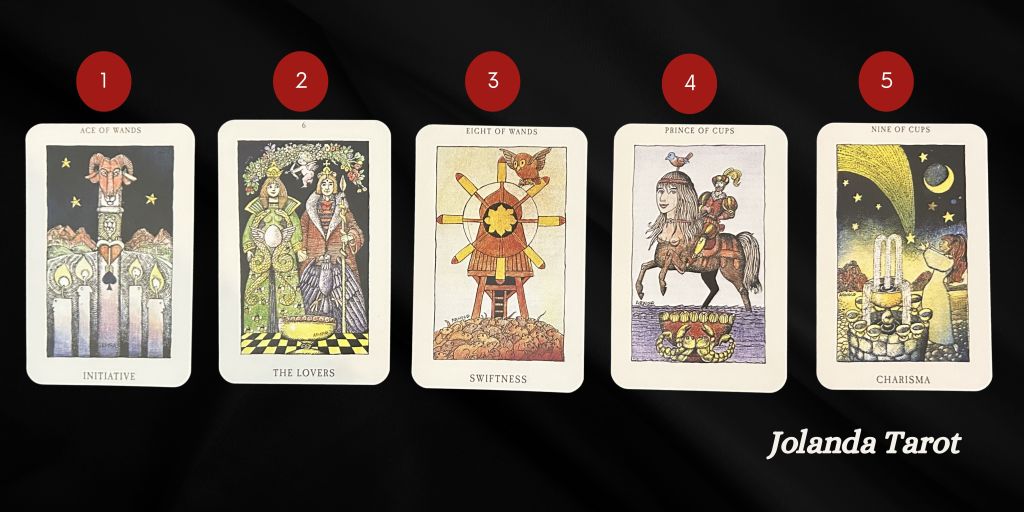
Here’s how it works:
Shuffle your deck while thinking about your situation. You don’t need to phrase it as a formal question unless you want to. “My job is making me miserable” works just as well as “What should I do about my career?” Trust that the cards will meet you where you are.
Pull five cards and lay them out in a row. No fancy formations necessary. Just five cards, left to right, like you’re reading a sentence.
Card 1: The Ground Floor (What’s Actually Happening)
This card shows you the mundane, practical, day-to-day reality of your situation. Not the spiritual meaning, not the deeper lesson, just what’s actually going on in the material world. What are the facts? What are you dealing with on a Tuesday afternoon level?
If you’re asking about a relationship, this might show you the actual dynamics at play. If you’re asking about a decision, this might show you the practical considerations. If you’re asking about your job, this might show you what your daily experience actually is, stripped of the stories you tell yourself about it.
This is your “what is” card. Look at it clearly.
Card 2: The View from Above (What It Means)
Now we go up a level. This card shows you the spiritual, emotional, or psychological dimension of your situation. What’s the deeper pattern here? What’s your soul trying to work out? How does this situation fit into your larger journey?
This is where the bridge happens, where we connect the mundane reality of Card 1 to the bigger picture. Maybe your annoying coworker (Card 1) is actually triggering an old wound about not being heard (Card 2). Maybe your impulse to buy that expensive thing (Card 1) is actually about trying to fill an emotional need (Card 2).
This card gives you context. It helps you understand why this situation matters, why it’s showing up now, what it’s asking you to see or learn or heal.
Card 3: The Tangle (Where’s the Mess?)
Here’s where we get honest about what’s actually complicated. This card shows you where things are knotted up, where you’re stuck, where the chaos lives. It might point to conflicting desires, unclear options, emotional blocks, practical obstacles, or just the general “I don’t know what the hell I’m doing” feeling that comes with being human.
This card isn’t here to make you feel bad. It’s here to help you see what you’re actually dealing with so you can stop pretending it’s simpler than it is. You can’t untangle a knot if you won’t look at it.
Sometimes this card is uncomfortable. That’s okay. Sit with it. What is it showing you that you’ve been avoiding or minimizing or trying to think your way around?
Card 4: The Move (What You Can Actually Do)
Alright, enough mapping. What now? This card shows you a concrete action, strategy, or approach you can take. Not “the answer” to your whole situation, just your next move. The thing you can actually do with the information you now have.
This might be an external action: have the conversation, make the call, set the boundary, try the thing. Or it might be an internal shift: change your perspective, release the expectation, accept the reality, give yourself permission.
The key word here is actionable. This isn’t “trust the universe” (though sometimes that IS the action, to stop trying to control everything). This is “here’s what you can do with your actual human hands and heart and voice.”
Card 5: The Wink (Don’t Forget to Breathe)
This last card is my favorite. It’s the reminder not to take any of this so seriously that you forget to be human. It’s the permission to laugh, to play, to remember that even your biggest problems are happening within the context of a wild, weird, temporary existence on a spinning rock in space.
This card might show you where you need to lighten up. Where you’re being too rigid or too hard on yourself. Where you’ve forgotten that it’s okay to not have it all figured out. It might point to joy, to humor, to the absurdity of your situation, to the grace that’s available if you stop clenching so hard.
Sometimes this card is gentle. Sometimes it’s cheeky. Sometimes it’s a straight-up cosmic joke. However it shows up, let it remind you that you’re allowed to be imperfect, to make mistakes, to not know, to try things that don’t work, to be a glorious mess of a human doing your best.
A note on using this spread: You can use it for literally anything. I mean it. I’ve used it to decide whether to adopt a dog, to process a breakup, to figure out a business strategy, and to determine if I should dye my hair (I should not have, but the cards tried to warn me). The spread doesn’t care how “important” your question is. It just helps you see clearly, think strategically, and remember to breathe.
Try it. See what happens. And if you pull cards that confuse you or don’t seem to make sense, that’s okay too. Sit with them. Come back to them later. Ask follow-up questions. Tarot is a conversation, not a decree. You’re allowed to not understand something right away. You’re allowed to disagree with what you see. You’re allowed to pull cards again tomorrow and get a completely different perspective.
That’s the whole point. This is a tool for you, not a test you can fail.
~Danielle


Leave a comment