Here’s a question: What’s the story you tell yourself about who you are?
Not the LinkedIn bio or the carefully curated Instagram caption. I mean the real story. The one that explains why you always end up in the same arguments with your mother, why you keep choosing partners who need “fixing,” or why you’ve convinced yourself you’re “not a creative person” despite the fact that you’ve been journaling for fifteen years. That story. The one running in the background like an operating system you never consciously installed.
That’s your personal mythology, and whether you realize it or not, you’re actively writing it every single day.
The good news? You can pick up the pen. You can revise. You can add plot twots, kill off tired narratives, and introduce new characters (metaphorically speaking). And one of the most effective tools for doing this work? Playing cards and fortunetelling decks. Not tarot with its mystical reputation and elaborate symbolism, but the straightforward, accessible decks that have been used for centuries: standard playing cards, Lenormand, Sibilla, Belline, and their cousins. These are the democratic tools of divination, the ones that don’t require you to memorize archetypes or invest in expensive guidebooks. They’re practical. They’re historically rooted. And they give you a language for the parts of your life that don’t fit neatly into spreadsheets or therapy worksheets.
Let’s talk about how we use these ancient, irreverent, surprisingly accessible tools to map the mess, strategize the cleanup, and consciously author the myths we’re living.
What Even Is Personal Mythology?
Your personal mythology is the story you tell about your life. Not the facts of what happened, but what it all means. It’s how you understand where you’ve been, who you are, and where you’re going. It’s the lens through which you make sense of the chaos.
And here’s the kicker: it’s not fixed. Your personal mythology is the actual story you’re living and constructing daily, the one that shapes how you interpret events, make decisions, and understand your place in the world. It’s active. It’s creative. And it’s completely editable.
Think of it as the difference between “things that happen to me” and “the story I’m telling about the things that happen to me.” One is passive. The other is active, creative, and (crucially) editable. When you engage consciously with your personal mythology, you move from being a character in someone else’s narrative to being the author of your own. You get to decide what the divorce meant, what the career change signified, what the pattern of always being the caretaker saysabout you (and whether you want to keep saying it).
This is where fortunetelling decks come in. They’re mirrors. They reflect back the story you’re actually telling, not the one you think you’re telling. Pull the Nine of Spades (or the Coffin in Lenormand) when asking about a relationship, and suddenly you’re confronting the “this is already over” narrative you’ve been avoiding. Draw the Anchor and you might see how deeply you’ve mythologized yourself as “the stable one,” the person everyone else leans on. The cards don’t write your mythology for you. They show you what you’re already writing so you can decide if you want to keep the plot.
This is identity work. This is meaning-making. And fortunetelling decks give you a practical, tangible way to do it.
Symbolic Systems: A Vocabulary for the Ineffable
So how do fortunetelling decks and playing cards fit into this? Simple: they function as a vocabulary for things that are notoriously hard to articulate.
Symbolic systems translate the abstract and ineffable into tangible images and structures. They give you a way to talk about concepts like “transition,” “shadow work,” “abundance,” or “stagnation” without resorting to therapy-speak or vague hand-waving. The Coffin doesn’t just mean “ending.” It means the kind of necessary closure that lets you stop carrying what’s already dead. The Crossroads isn’t just “decision,” it’s the moment when you have to pick a direction and own it. The Snake shows you where complications are tangling things up, and the Clover reminds you where ease is actually available if you’d stop making everything so hard.
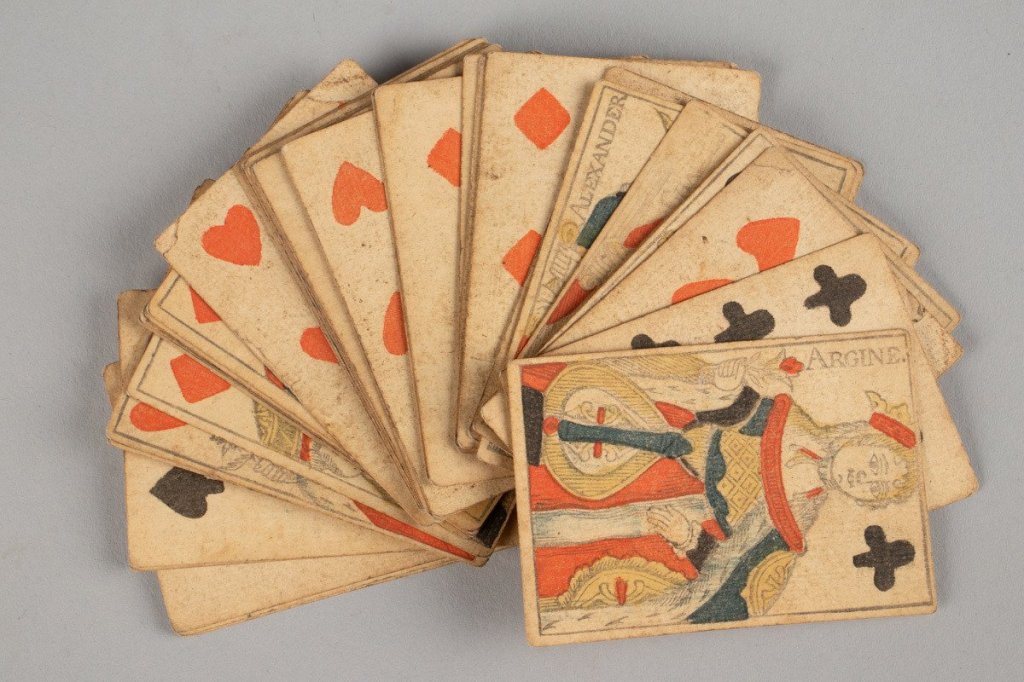
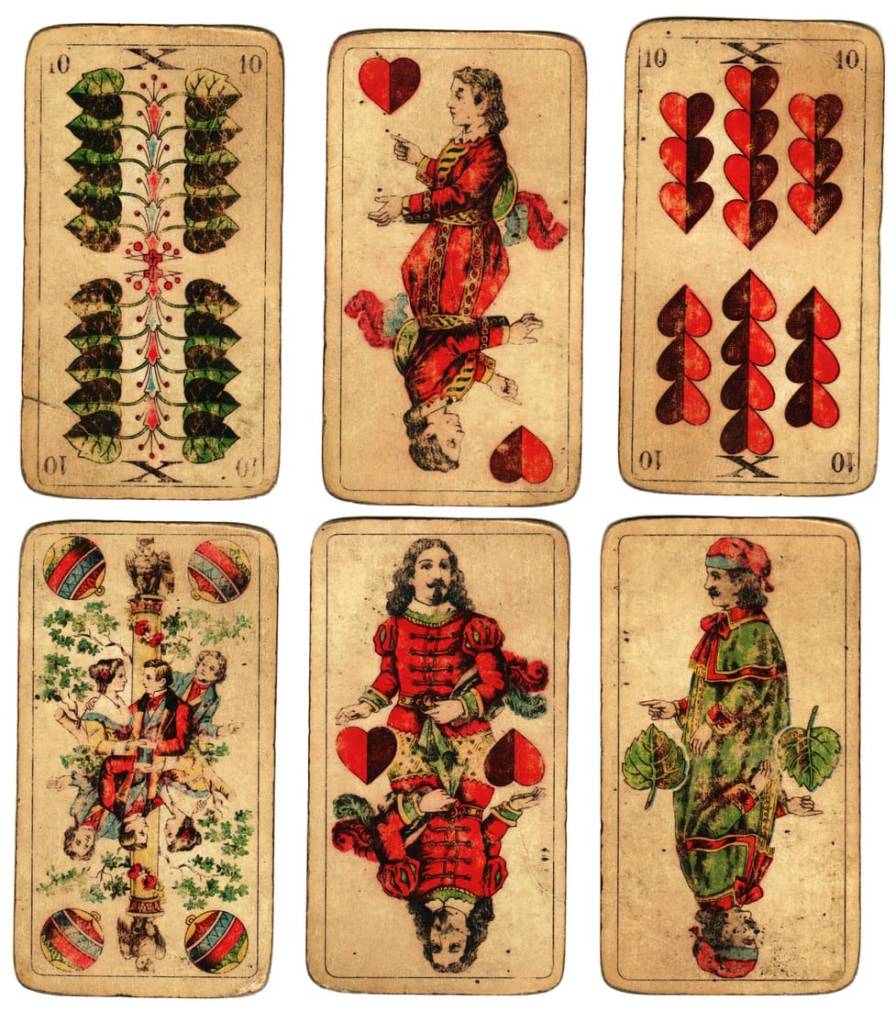
Why fortunetelling decks and playing cards specifically? Because they’re clear. They have straightforward meanings rooted in real life, not cryptic mystical symbolism that requires a PhD to decode. They’re also historically rooted (more on that in a second), which means they carry centuries of collective meaning-making. And perhaps most importantly, they’re democratic. You don’t need special powers or mystical lineage to use them. You just need a deck and genuine curiosity.
Playing cards, in particular, are radically accessible. They’re in every drugstore, every gas station, every junk drawer. They’re completely demystified. They’re the people’s divination tool (humble, ubiquitous, and deeply potent once you learn their language).
Mapping Messiness: Divination as Life Strategy
Here’s where we get practical. How do you actually use symbolic systems to work with your personal mythology?
You use them to externalize the internal. When you’re stuck in a decision, spiraling in anxiety, or trying to understand a pattern, you lay out cards. Suddenly, the chaos in your head has a shape. It has positions, relationships, a narrative arc. The cards don’t tell you what to do (they give you a framework for asking better questions.
Let’s say you keep ending up in jobs where you feel undervalued. You pull cards to explore this pattern. You get the Anchor (you’re stuck holding on to what’s comfortable), the Crossroads (you’re at a decision point but not choosing), and the Snake (you’re tangling yourself up to fit in). Suddenly, you’re not just “unlucky with jobs” (you’re seeing a story about how you prioritize safety over authenticity, how you avoid making the hard choice, how you complicate things to stay small. That’s actionable intelligence. That’s a pattern you can actually work with.
Or maybe you’re navigating a major life transition: a breakup, a move, a career pivot. You use a spread to map where you’ve been, where you are, and where you’re going. The cards become a mirror, reflecting back the narrative you’re already living but haven’t fully articulated. They help you identify what needs to be released, what needs to be integrated, and what wants to emerge.
This is the bridge between spiritual and mundane. This is divination as strategy. You’re not escaping reality, you’re getting better at navigating it.
Mythic Mirror Fortunetelling Spread
Ready to try it yourself? Here’s a spread designed specifically for fortunetelling decks and playing cards. Because these decks are direct and straightforward, pairing two cards in each position creates nuance and relationship; the cards speak to each other, revealing the complexity of your story without losing clarity.
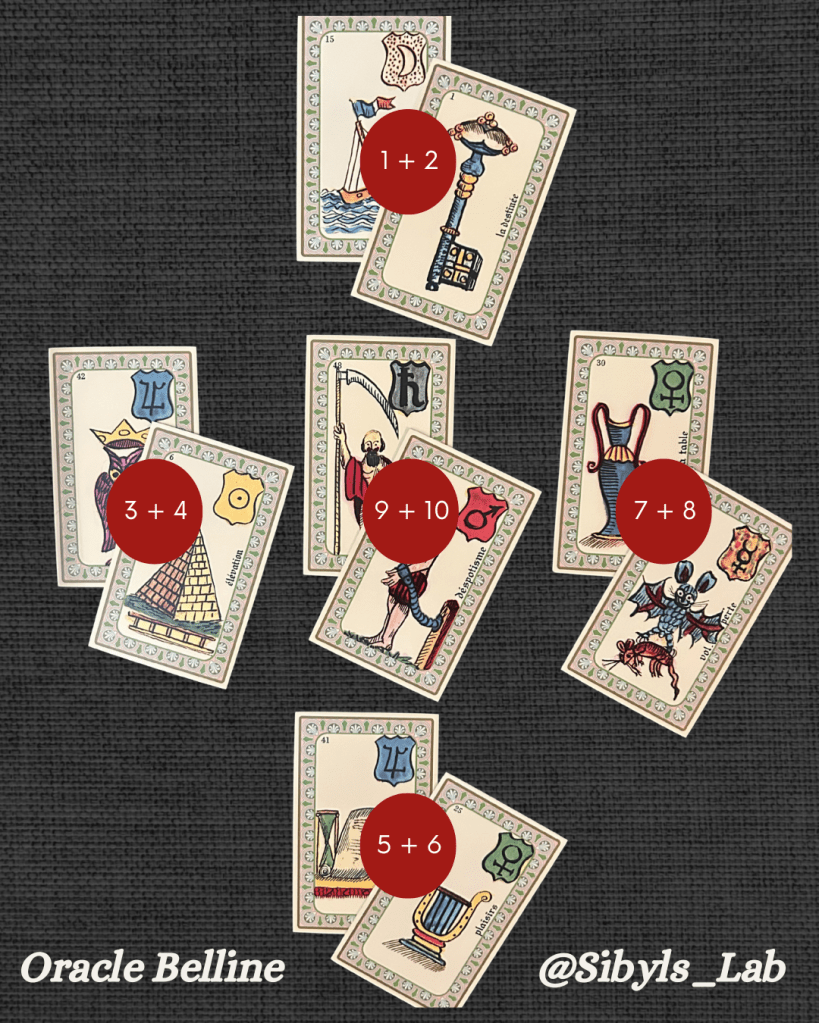
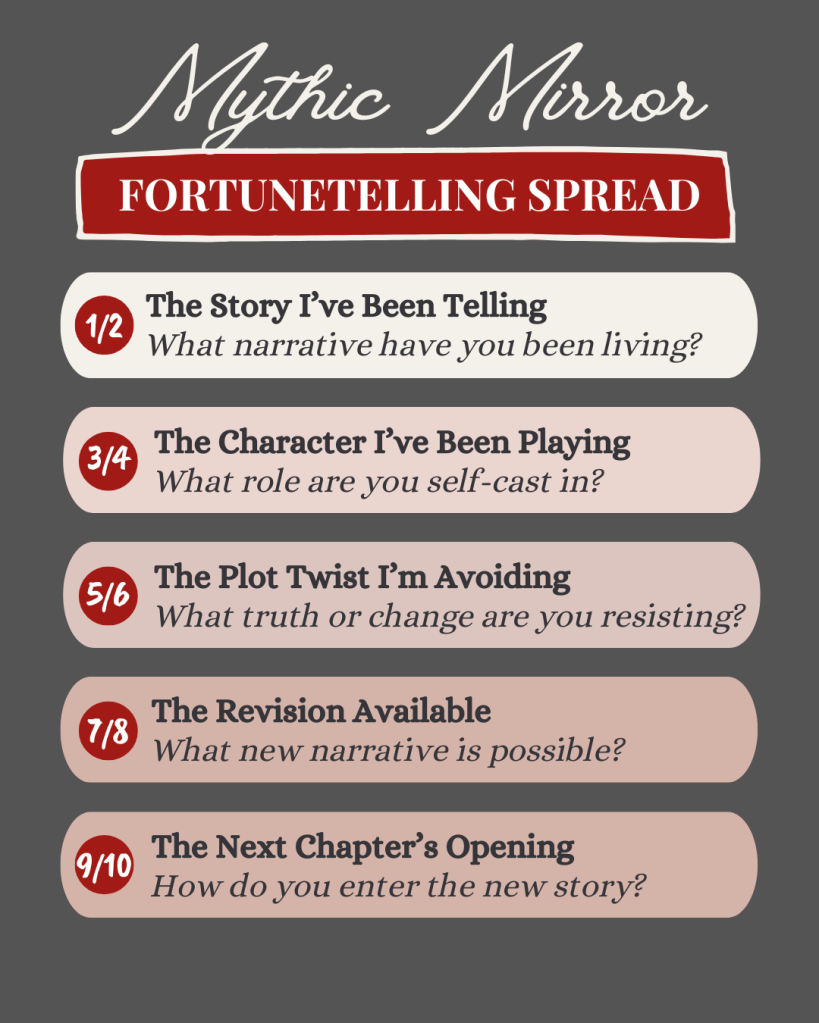
Position 1 & 2: The Story I’ve Been Telling
What narrative have you been living? What’s the dominant theme or pattern? (Look for cards like Anchor for stability/stuckness, Snake for complications, House for foundation, or court cards showing the energy you’ve been embodying.)
Position 3 & 4: The Character I’ve Been Playing
What role have you cast yourself in? The hero? The victim? The caretaker? The rebel? (Kings and Queens can show authority or control; Clover might reveal someone playing it easy; Spades/Swords often point to conflict or cutting through.)
Position 5 & 6: The Plot Twist I’m Avoiding
What change or truth are you resisting? What wants to disrupt the current story? (Crossroads signals a choice point; Coffin marks a necessary ending; Whip can show the disruption or conflict you’re dodging.)
Position 7 & 8: The Revision Available
What new narrative is possible? How can you reframe or rewrite this chapter? (Look for cards suggesting movement, new possibility, or clarity: Birds for communication, Key for solutions, Stars for hope and direction.)
Position 9 & 10: The Next Chapter’s Opening Line
What’s the first step toward living this new story? What action or shift begins the revision? (Action-oriented cards like Rider for movement, Ship for journey, or number cards showing momentum and progression.)
Lay out your fortunetelling deck or playing cards. Sit with each pair. Notice what the cards reveal about the story you’re already living in straightforward terms. Journal. Let the cards talk to each other. This is your mythology, and you’re the author.
Ready to Go Deeper?
If this work resonates and you want structured guidance for exploring symbolic systems, check out The Cartomancer’s Path: A Playing Card Workbook by Amelia. It’s a five-part written course designed to help you connect to the sacred mundane of your life through a humble, powerful playing card deck.
This isn’t about becoming a “professional reader” (unless you want to be). It’s about developing a personal practice that bridges the spiritual and the practical, that honors both your intuition and your need for strategy. It’s about learning the language of symbols so you can speak more fluently about your own life.
Your mythology is already being written. Might as well pick up the pen.
Explore The Cartomancer’s Path →


Leave a comment