
The dystopian genre has captivated readers and writers for generations, offering stark warnings about the trajectories of our societies, technologies, and human nature itself. From Orwell’s surveillance state in 1984 to Atwood’s theocratic nightmare in The Handmaid’s Tale, dystopian narratives force us to confront uncomfortable truths about power, control, oppression, and resistance. But dystopian themes aren’t just for novelists and filmmakers—they’re powerful tools for personal reflection, creative exploration, and understanding the world around us.
In this first post (of a two-part series) we’ll start to explore an unconventional but deeply rewarding approach to engaging with dystopian themes: combining tarot reading with intentional journaling. This practice allows you to tap into the archetypal wisdom of the tarot while using structured prompts to examine dystopian concepts in your own life, creative work, and understanding of society.
If you’d appreciate a list of decks suited to this work, along with a real-time conversation about these themes, check out this video on YouTube, posted on Friday, October 24th. However you consume these ideas, though, keep in mind that whether you’re a writer developing a dystopian story, a reader wanting to engage more deeply with the genre, or simply someone interested in examining the darker possibilities of human civilization, this fusion of divination and reflection offers profound insights.
When Divination Meets Dark Futures
At first glance, tarot cards and dystopian fiction might seem like an odd pairing. However, both systems deal fundamentally with archetypes, power dynamics, transformation, and the human condition under pressure. Tarot has been used for centuries as a tool for introspection, decision-making, and understanding the forces at play in our lives. The cards present universal human experiences—from the oppressive authority of The Emperor to the revolutionary energy of The Tower, from the isolation of The Hermit to the collective consciousness of The World.
Dystopian fiction similarly works with archetypes and examines what happens when social structures become corrupted, when technology outpaces ethics, when individual freedoms are sacrificed for supposed collective security, or when environmental collapse forces humanity into survival mode. Both tarot and dystopian narratives ask us to look unflinchingly at difficult truths and consider how we might navigate challenging circumstances.
The tarot provides a symbolic language that can help us access intuitive understanding of dystopian themes. When we pull cards with the intention of exploring concepts like surveillance, authoritarianism, environmental collapse, or resistance, we create a bridge between the abstract ideas in dystopian fiction and our lived experiences. The cards become mirrors reflecting both the fictional worlds we’re exploring and the dystopian elements already present in our reality.
Furthermore, tarot readings naturally generate questions and insights that can be expanded through journaling. The combination creates a powerful feedback loop: the cards provide symbolic prompts and intuitive hits, while journaling allows us to process, analyze, and integrate those insights into coherent understanding. This practice can deepen your appreciation of dystopian literature, enhance your creative writing in the genre, or simply help you think more critically about the direction of contemporary society.
The Dystopian Language of Tarot
Before we dive into specific spreads and prompts, it’s helpful to consider how different tarot cards naturally align with common dystopian themes. While any card can be interpreted through a dystopian lens depending on context, certain cards particularly resonate with the genre’s core concerns.
The Major Arcana and Macro-Themes
The Major Arcana cards represent significant life themes and archetypal energies that map beautifully onto dystopian narratives:
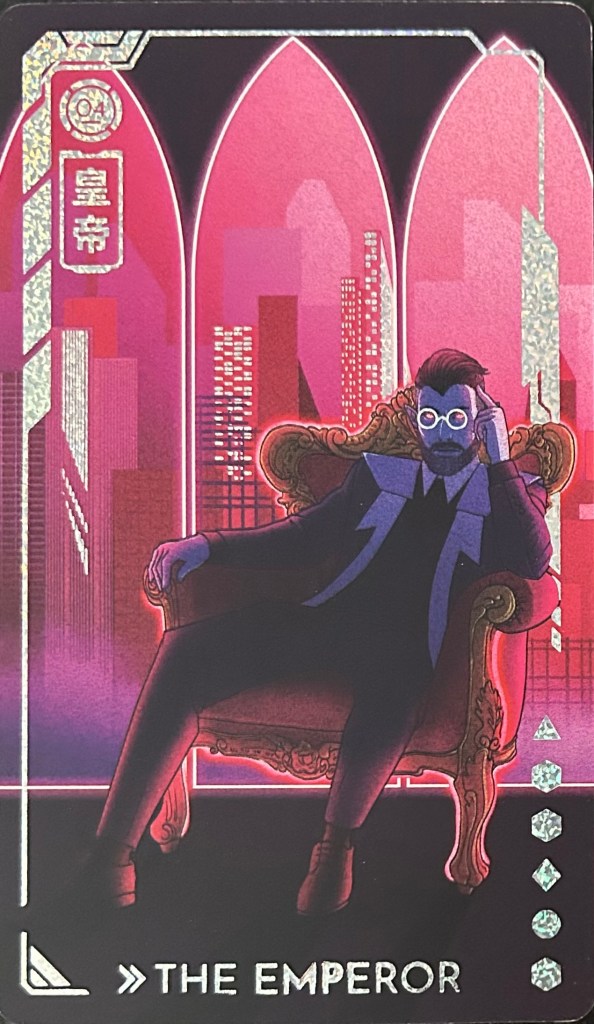
The Emperor embodies authoritarian control, rigid hierarchies, and the patriarchal power structures that dominate many dystopian societies. In its shadow aspect, this card represents tyranny, oppressive laws, and the crushing of individual expression under the weight of absolute authority. Think of Big Brother in 1984 or the totalitarian regime in V for Vendetta. (Deck: Eldritch Overload Tarot)
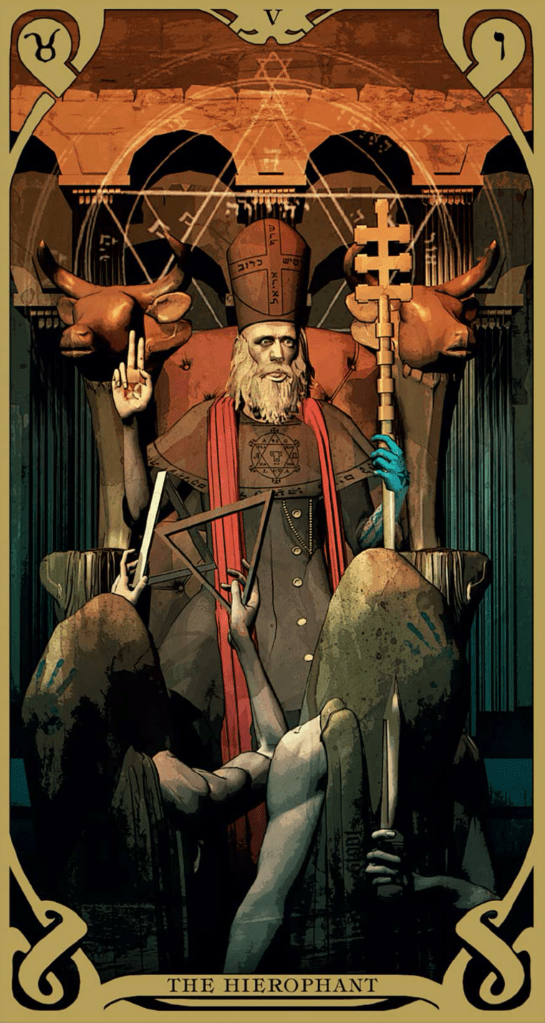
The Hierophant speaks to institutionalized belief systems, dogma, and the control of information and ideology. In dystopian contexts, this card can represent state-mandated religions, propaganda machines, or the educational systems that indoctrinate rather than enlighten. Consider the theocracy of Gilead in The Handmaid’s Tale or the Party’s control of history in 1984. (Deck: Night Sun Tarot)
The Tower is perhaps the most overtly dystopian card in the deck, representing sudden collapse, the destruction of established systems, and the chaos that follows when structures we depend on crumble. This card embodies both the catastrophic events that create dystopian worlds (environmental collapse, nuclear war, pandemic) and the revolutionary moments when oppressed people rise up to tear down their oppressors.
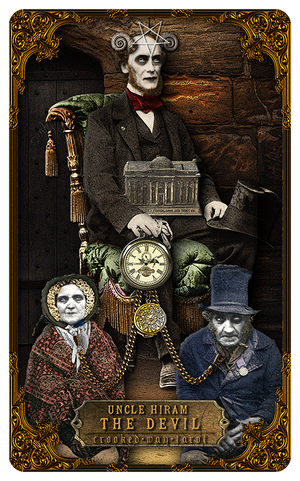
The Devil represents bondage, addiction, materialism, and the ways we become complicit in our own oppression. In dystopian readings, this card might point to the seductive nature of convenience and comfort that keeps populations docile, the surveillance capitalism that trades privacy for services, or the ways characters become trapped in systems they know are wrong. (Deck: Crooked Way Tarot)
The Moon speaks to deception, illusion, and the difficulty of discerning truth from lies—a central concern in dystopias where reality itself is often manipulated. This card resonates with themes of gaslighting, false memories, manufactured consent, and the fog of propaganda that obscures truth. (Deck: Eldritch Overload Tarot)


The Hanged Man represents suspension, sacrifice, and seeing things from a radically different perspective. In dystopian narratives, this card can symbolize the moment when a character begins to question the reality they’ve always accepted, the sacrifice required for resistance, or the liminal state of being caught between compliance and rebellion. (Deck: Night Sun Tarot)
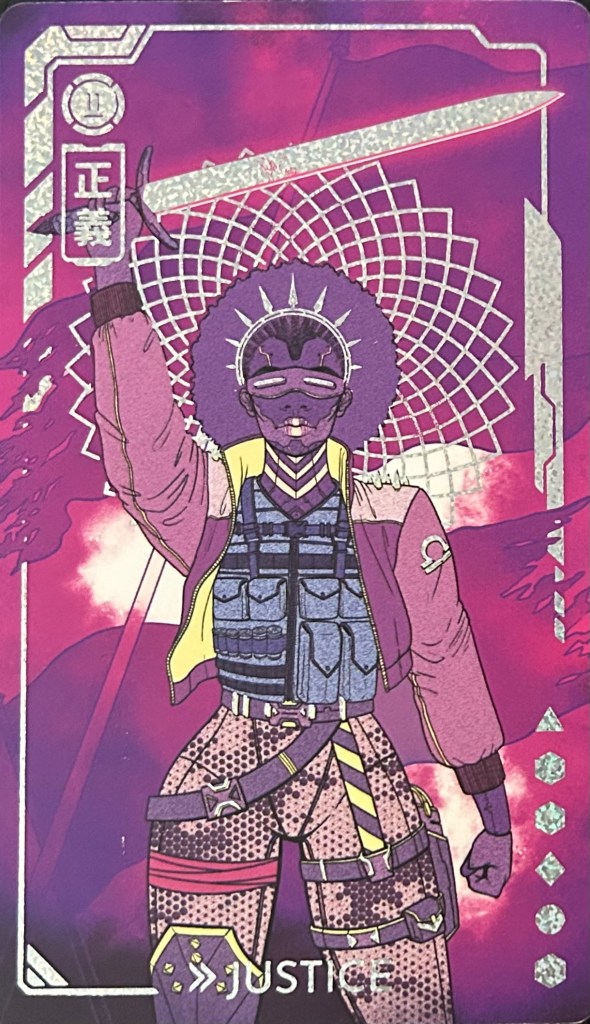
Justice (or Adjustment in some decks) becomes particularly interesting in dystopian contexts, as it asks us to consider what justice means when legal systems are corrupt, when laws themselves are unjust, or when the very concept of fairness has been perverted to serve authoritarian ends. (Deck: Eldritch Overload Tarot)
The Minor Arcana and the Everyday
While the Major Arcana provides the big themes, the Minor Arcana cards help us explore how dystopian conditions affect daily life, relationships, and individual psychology:
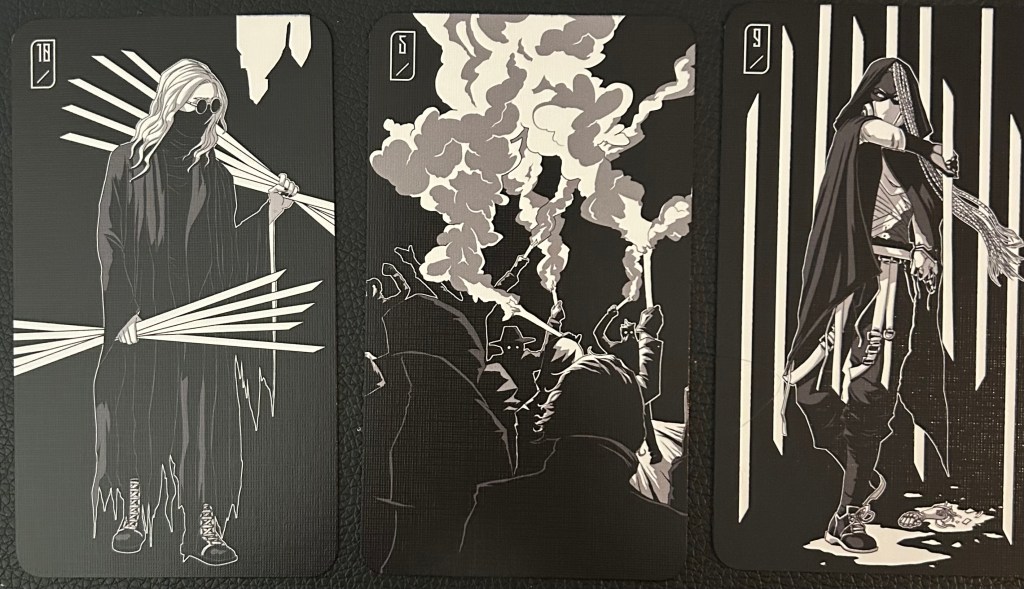
The Suit of Wands represents passion, creativity, and willpower—the fire that fuels resistance and rebellion. Cards like the Five of Wands (conflict and competition for resources), the Seven of Wands (defending your position against opposition), and the Eight of Wands (rapid change and communication) can illuminate themes of resistance, underground movements, and the spread of revolutionary ideas. (Deck: Teknebrae Tarot)
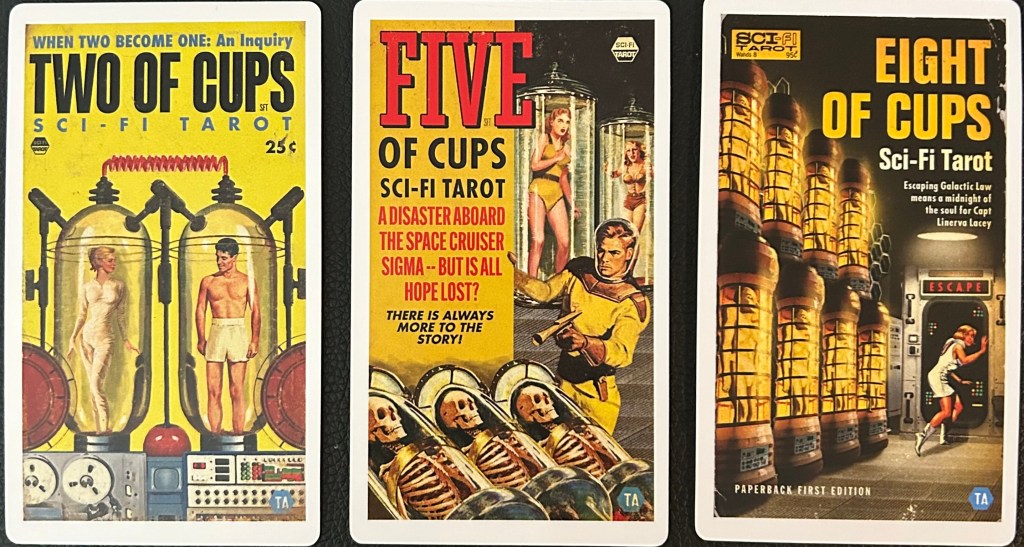
The Suit of Cups explores emotions, relationships, and the human heart—aspects of life that dystopian regimes often seek to control or eliminate. The Four of Cups (apathy and disconnection), the Five of Cups (loss and grief), and the Eight of Cups (walking away from what no longer serves) all resonate with the emotional landscape of dystopian existence. (Deck: Sci-Fi Tarot)
The Suit of Swords deals with thoughts, communication, conflict, and truth—all crucial elements in dystopian stories. Cards like the Eight of Swords (feeling trapped by circumstances or beliefs), the Nine of Swords (anxiety and nightmares), and the Ten of Swords (betrayal and endings) speak directly to the psychological toll of living under oppression. (Deck: Teknebrae Tarot)
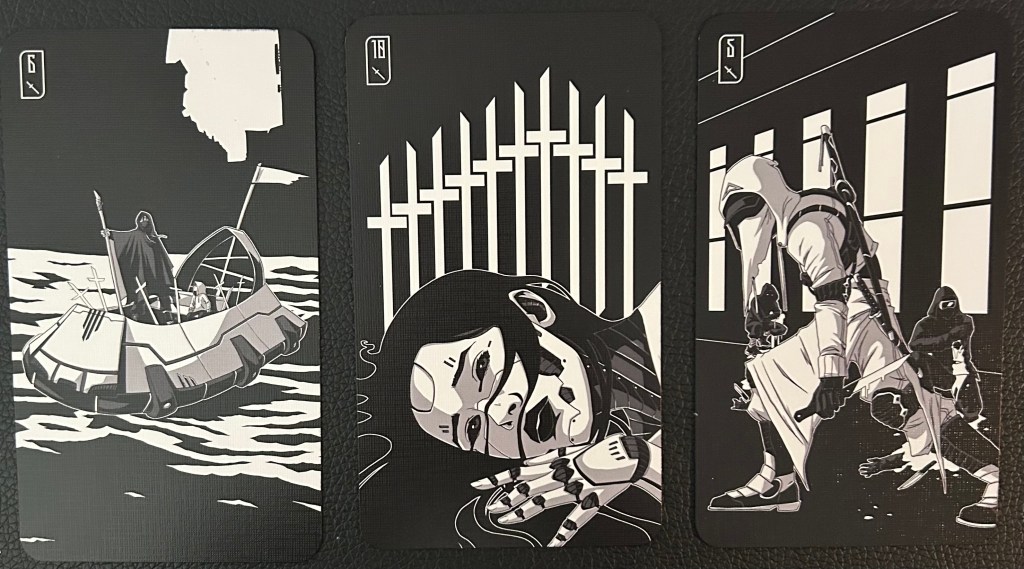
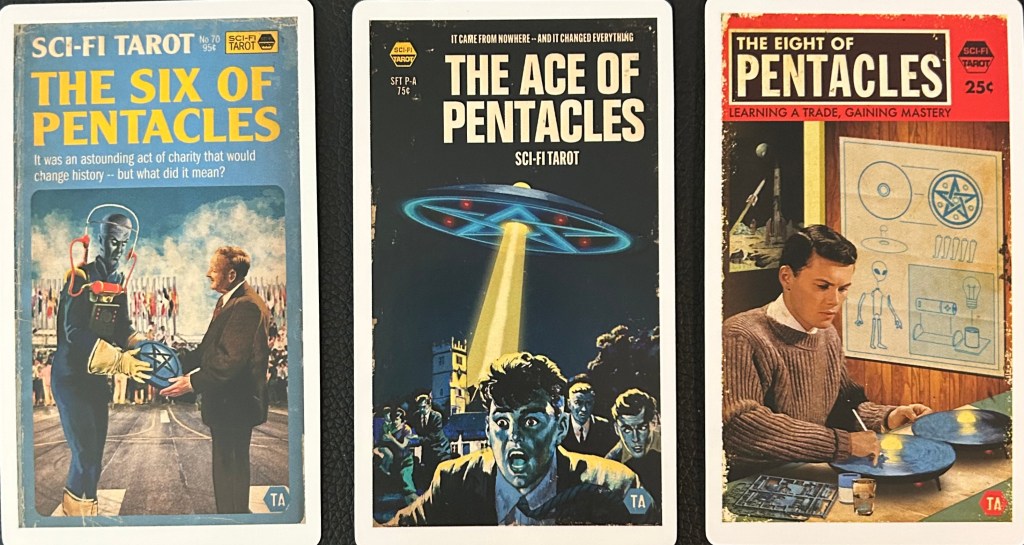
The Suit of Pentacles grounds us in material reality, resources, work, and physical survival—often the most pressing concerns in dystopian worlds. The Five of Pentacles (poverty and exclusion), the Seven of Pentacles (questioning whether your efforts are worthwhile), and the Ten of Pentacles (legacy and what we leave behind) all speak to economic injustice, resource scarcity, and the material conditions that shape dystopian societies. (Deck: Sci-Fi Tarot)
Tarot Spreads for Exploring Dystopian Themes
Now that we’ve established the connection between tarot and dystopian themes, let’s explore some specific spreads designed to help you engage with the genre more deeply. These spreads can be used for personal reflection, creative writing development, or analytical exploration of dystopian texts you’re reading. These are the first of four spreads; you can find the remaining two, along with a comprehensive list of journal prompts, in next week’s post.
The Dystopian Society Spread
This seven-card spread helps you explore the structure and dynamics of a dystopian society, whether fictional or as a lens for examining contemporary trends:
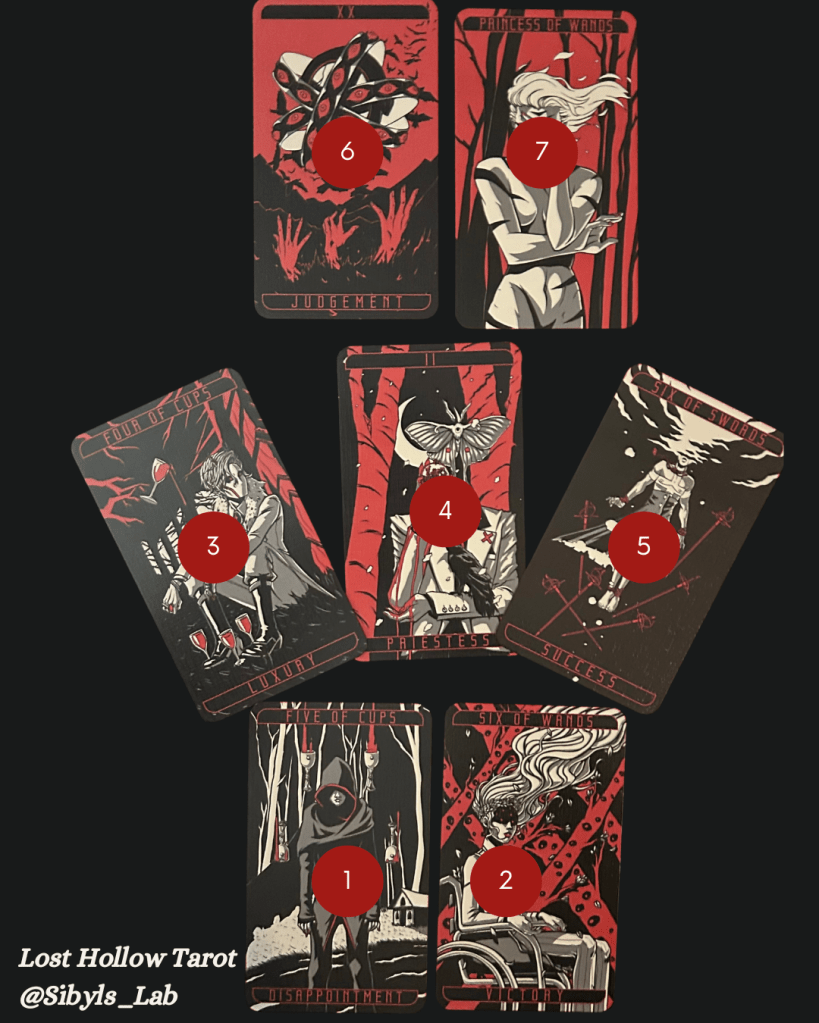
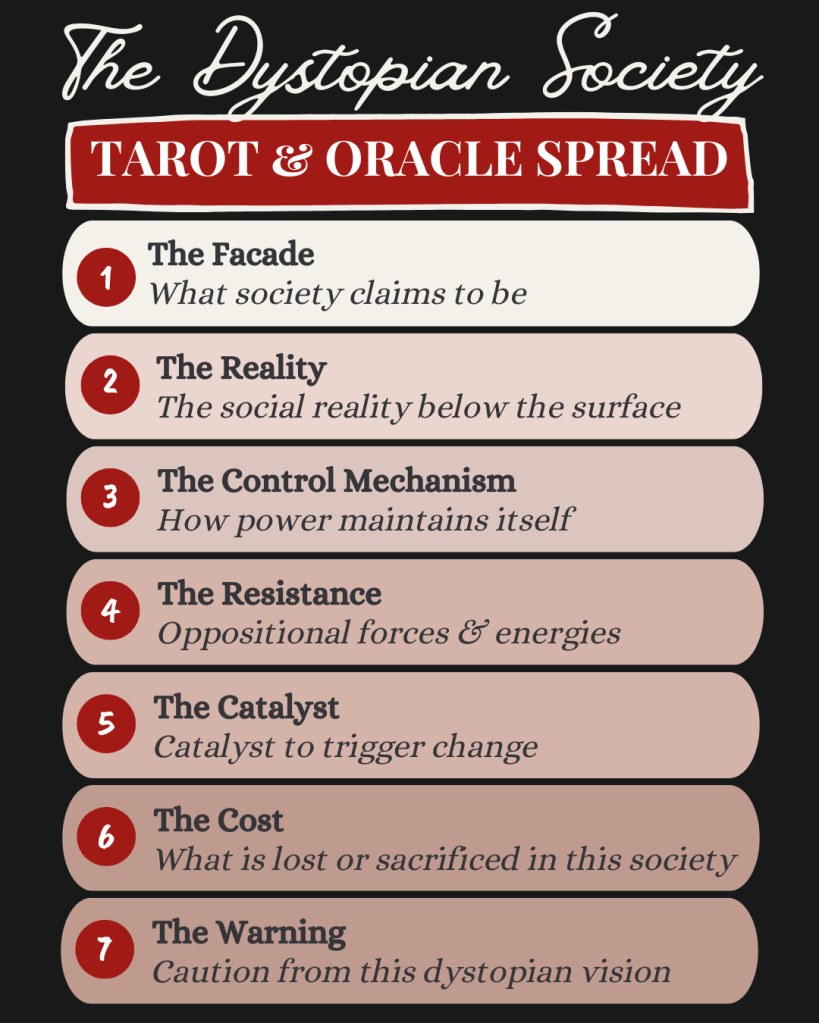
Position 1 – The Facade: What does this society claim to be? What is the official narrative or propaganda?
Position 2 – The Reality: What is the society actually like beneath the surface?
Position 3 – The Control Mechanism: How does power maintain itself? What keeps people compliant?
Position 4 – The Resistance: What forces or energies oppose the dominant power structure?
Position 5 – The Catalyst: What event or realization might trigger change?
Position 6 – The Cost: What is lost or sacrificed in this society?
Position 7 – The Warning: What does this dystopian vision warn us about in our own world?
When you lay out this spread, take time with each card. Notice not just the traditional meanings but also the imagery, colors, and symbols that might speak to dystopian themes. For example, if you pull The Sun in the “Facade” position, you might interpret this as a society that presents itself as enlightened, prosperous, and life-giving, while the card in the “Reality” position reveals what’s actually happening behind that bright exterior.
The Apocalyptic Actor Spread
This spread is particularly useful for writers developing characters for dystopian fiction, but it’s equally valuable for readers wanting to understand characters more deeply or for personal reflection on how you might respond to dystopian circumstances:
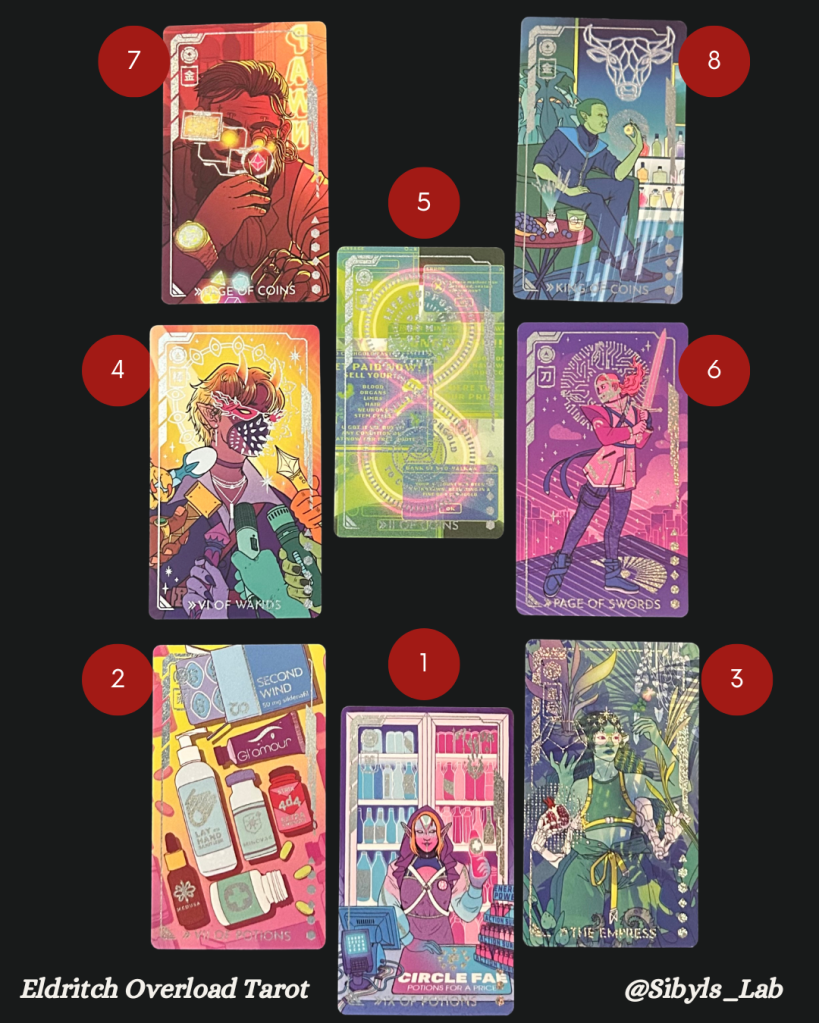
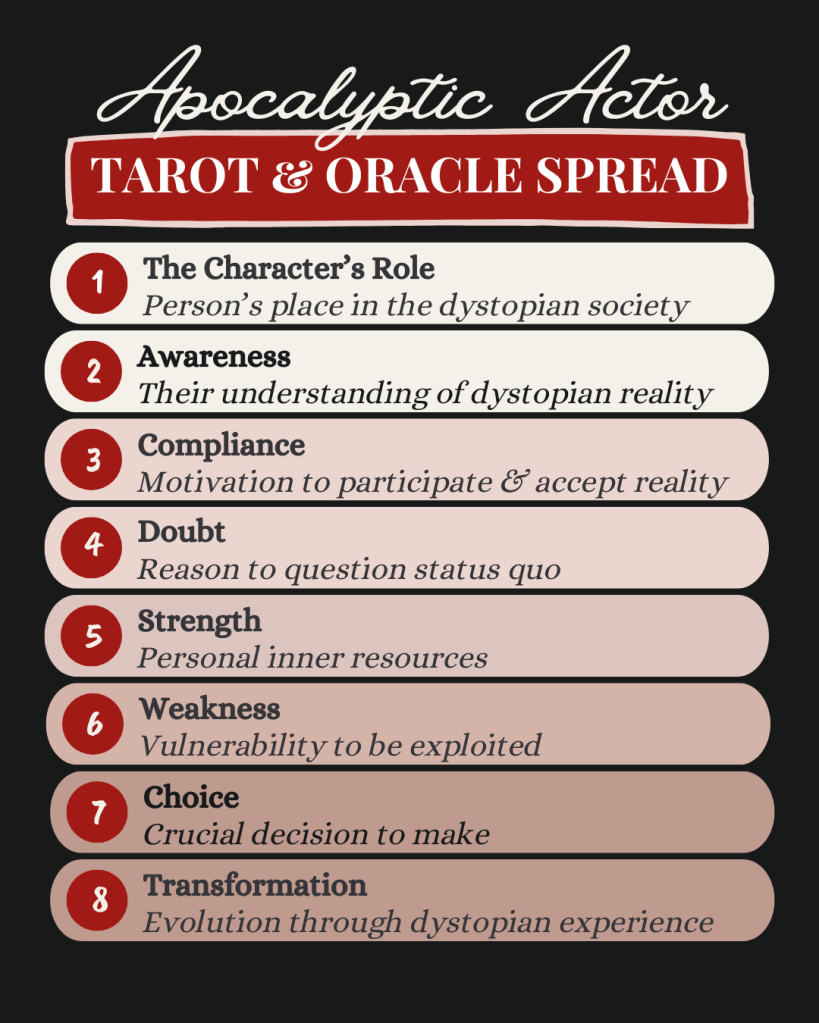
Position 1 – The Character’s Role: What is this person’s place in the dystopian society?
Position 2 – Their Awareness: How much do they understand about the true nature of their world?
Position 3 – Their Compliance: What keeps them participating in or accepting the system?
Position 4 – Their Doubt: What makes them question the status quo?
Position 5 – Their Strength: What inner resources do they possess?
Position 6 – Their Weakness: What vulnerability might be exploited or might lead to their downfall?
Position 7 – Their Choice: What crucial decision do they face?
Position 8 – Their Transformation: How might they change through their dystopian experience?


 Sibyl's Lab of Cartomantics
Leave a reply to Divination & Dystopia (Part 2): Tarot Spreads, Reading Strategies, & Journal Prompts – Sibyl's Lab of Cartomantics Cancel reply