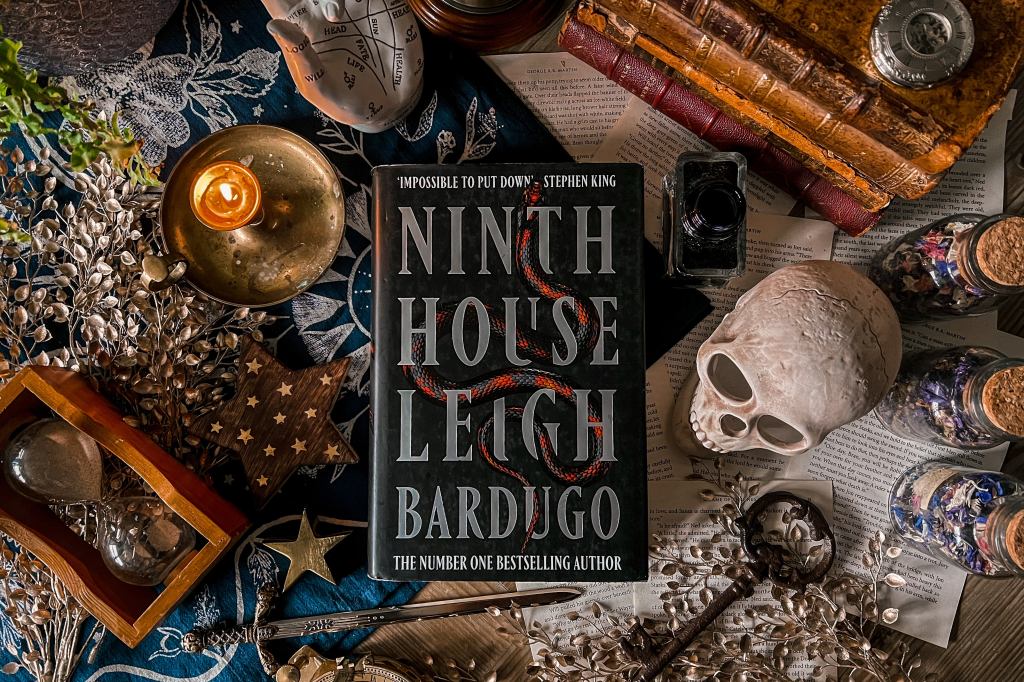
This is the fifth post in a series discussing where, how, and why tarot and fortunetelling show up as devices in literary fiction. In other words, they are an opportunity for a tarot-loving lit professor to indulge—with the ancient Sibyl’s permission, of course—two areas of passion and expertise. This week, we’ll be discussing Leigh Bardugo’s Ninth House (2019). Be warned: spoilers await.
The introduction to the “Fortunetelling & Fiction” series is available at this link: https://sibylslab.com/2025/06/06/fortunetelling-fiction-a-new-series-on-tarot-as-a-literary-device/. Previously reviewed texts include:
- “The Waste Land” by T.S. Eliot (1922)
- The Castle of Crossed Destinies by Italo Calvino (1973)
- Jonathan Strange & Mr. Norrell by Susanna Clarke (2004)
- Sepulchre by Kate Mosse (2007)
Now, onward to this latest entry in our series.
Reading the Room (and the Cards): On Divination and Dominance
Leigh Bardugo’s adult debut Ninth House incorporates tarot into its dark academic setting of secret societies at Yale University, creating a complex narrative framework where divination serves multiple symbolic and plot functions. The novel’s protagonist, Galaxy “Alex” Stern, has the ability to see ghosts and is recruited to monitor the magical activities of Yale’s elite secret societies—a role that positions her as both observer and participant in systems of occult power.
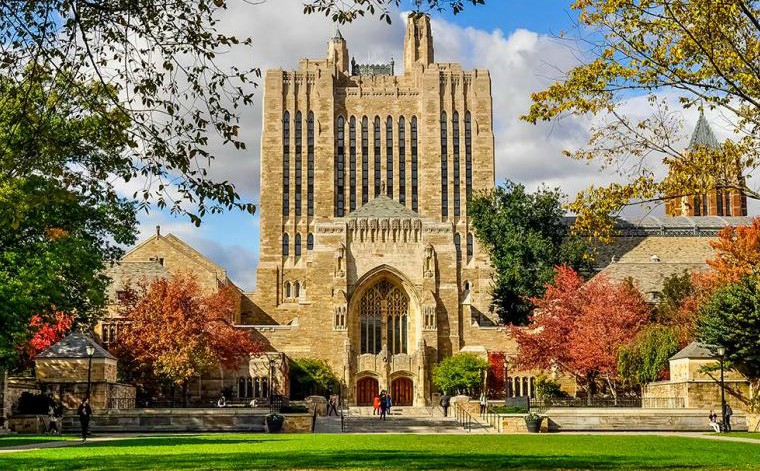
One of these societies, the Scroll and Key, specializes in various forms of divination including tarot. Their magical workings involve elaborate tarot spreads that can predict future events with unsettling accuracy, often requiring ritualistic elements that blur the line between performance and genuine supernatural practice. As Alex investigates a murder connected to these societies, tarot readings provide both clues and misdirection, functioning as a narrative device that simultaneously reveals and obscures truth. The cards become unreliable narrators in their own right, offering glimpses of reality filtered through symbolic interpretation.
Bardugo uses tarot to explore themes of privilege and power with particular sophistication. The secret societies’ use of divination represents how the elite access hidden knowledge unavailable to ordinary people, creating hierarchies based not just on wealth or social status, but on supernatural insight. Tarot becomes a symbol of institutional power—the ability to see (and potentially shape) the future gives these societies tremendous advantages in business, politics, and personal relationships. This mirrors real-world dynamics where information asymmetry perpetuates inequality, but Bardugo literalizes the metaphor through actual prophecy.
The novel’s treatment of tarot also reflects broader anxieties about academic elitism. Yale’s secret societies have long been associated with networks of power that extend far beyond university walls, and by making their influence explicitly magical, Bardugo suggests that elite institutions possess forms of knowledge and capability that fundamentally separate them from the rest of society. The tarot readings become a kind of insider trading for reality itself.
Furthermore, the novel uses tarot to examine determinism versus free will in ways that complicate traditional interpretations of fate. As predictions come true throughout the story, characters must decide whether to accept these outcomes or fight against them, but their resistance often seems to fulfill the prophecies in unexpected ways. This tension reflects the dual nature of tarot itself—a system that acknowledges both cosmic patterns and individual agency. Alex’s position as monitor places her in the unique role of someone who can see the future being constructed but struggles with how much she can or should intervene.
The cards also serve as a meditation on class mobility and the price of accessing elite spaces. Alex’s working-class background makes her an outsider to the societies’ privileges, yet her supernatural abilities grant her a different kind of power. The tarot readings become a space where her intuitive knowledge can compete with the societies’ institutional advantages, though this access comes at significant personal cost.
Through its nuanced use of tarot symbolism, Ninth House ultimately suggests that divination—like privilege itself—is less about predetermined fate than about the power to interpret and act upon information. The novel’s dark academic atmosphere transforms tarot from a tool of personal insight into an instrument of systemic control, making visible the hidden mechanisms by which elite institutions maintain their influence across generations.
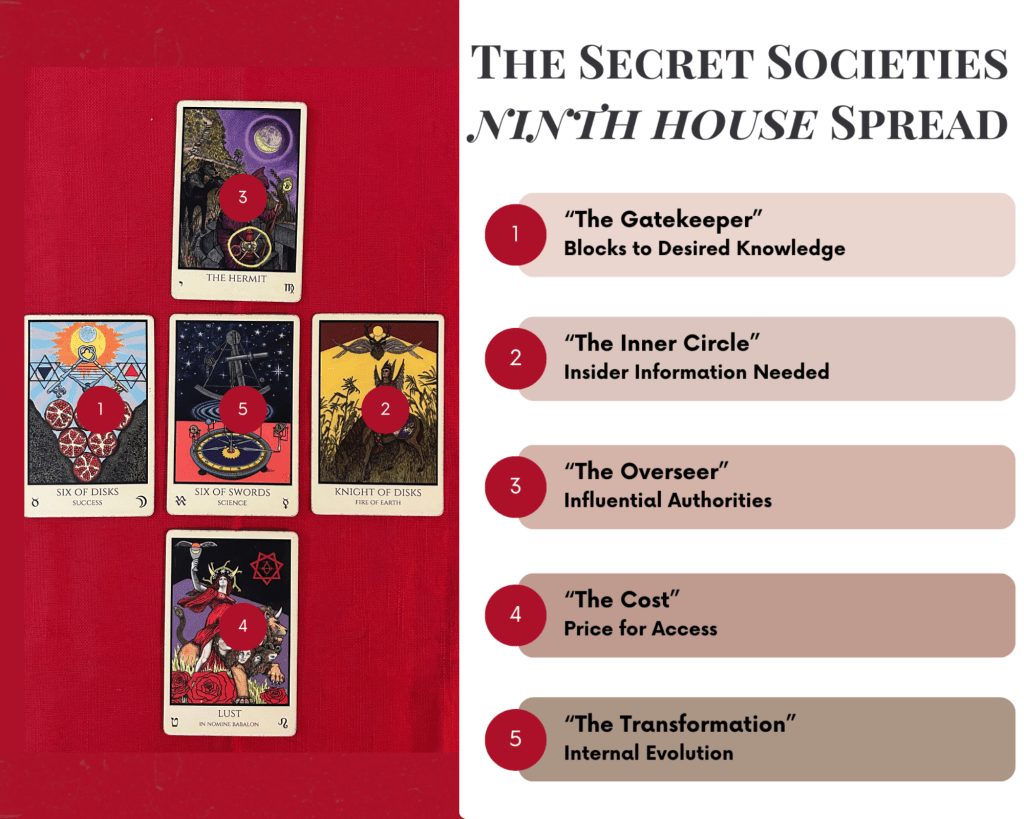
The Secret Society Ninth House Tarot Spread
Inspired by the power dynamics in Ninth House, this five-card spread explores how hidden knowledge and institutional privilege shape one’s path:
Card Positions:
- The Gatekeeper – What barriers or gatekeepers currently block your access to desired knowledge or opportunities?
- The Inner Circle – What hidden advantages or insider information do you possess (or need to cultivate)?
- The Overseer – What higher power or authority figure influences your situation from above?
- The Cost – What price must you pay to gain access to this elite knowledge or position?
- The Transformation – How will navigating these power structures ultimately change you?


 Sibyl's Lab of Cartomantics
Leave a comment