In the realm of literature, authors have long been drawn to the mysterious allure of tarot cards. These ancient divination tools, with their rich symbolism and archetypal imagery, offer writers a powerful narrative framework that transcends mere fortunetelling. When woven skillfully into fiction, tarot cards become more than props—they transform into essential plot devices, character development tools, and thematic anchors that guide readers through complex storytelling journeys. If you love reading cards and stories, follows this blog series of short musings, each on a few literary examples that you may want to explore in greater depth. But be warned: spoilers await.
Each of the 78 tarot cards carry multiple layers of meaning, making them perfect vehicles for authors seeking to embed symbolism, foreshadowing, and metaphor into their narratives. What makes tarot particularly compelling for fiction writers is its versatility. In some novels, the cards function as literal divination tools within the story world. In others, they provide structural frameworks for the narrative itself. Some authors use tarot imagery as metaphorical touchstones, while others build entire magical systems around these enigmatic cards.
Let’s explore some of the most fascinating works of fiction where tarot cards transcend decoration, anachronism, or curiosity and become integral to the plot, character development, and thematic resonance. We’ll start with T.S. Eliot “The Waste Land”; its full text can be found here: https://www.poetryfoundation.org/poems/47311/the-waste-land. Eliot’s poem is the chronological first in the growing list of texts to be discussed:
- “The Waste Land” by T.S. Eliot (1922)
- The Greater Trumps by Charles Williams (1932)
- The Castle of Crossed Destinies by Italo Calvino (1973)
- Last Call by Tim Powers (1992)
- Jonathan Strange & Mr. Norrell by Susanna Clarke (2004)
- Sepulchre by Kate Mosse (2007)
- The Tarot of Perfection by Rachel Pollack (2008)
- The Night Circus by Erin Morgenstern (2011)
- Arcanum by Simon Morden (2014)
- The Devourers by Indra Das (2015)
- The Tarot Sequence by K.D. Edwards (2018)
- Ninth House by Leigh Bardugo (2019)
- The Midnight Bargain by C.L. Polk (2020)
- The Tarot Cafe Series by Sang-Sun Park (2002-06)
- The Raven Cycle Series by Maggie Stiefvater (2012-16)
- The Diviners Series by Libba Bray (2012-20)
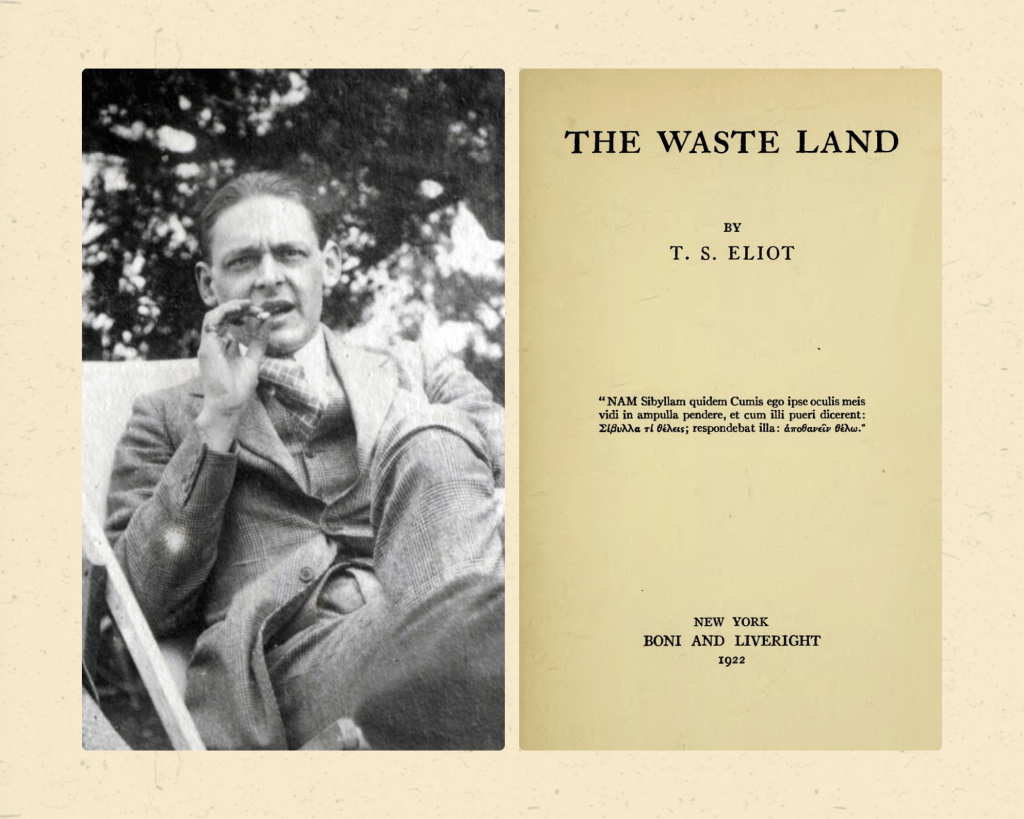
T.S. Eliot & Tarot as Poetic Instrument
While not a novel, T.S. Eliot’s revolutionary poem “The Waste Land” (1922) deserves particular attention for its sophisticated and influential deployment of tarot imagery as both structural framework and thematic catalyst. Far from mere occult decoration, Eliot’s integration of divinatory symbolism represents one of modernist literature’s most complex examples of how esoteric traditions can be repurposed to address the spiritual crisis of modernity.
The poem’s first section, “The Burial of the Dead,” introduces the clairvoyant Madame Sosostris, whose tarot reading becomes a prophetic blueprint for the entire work. Her cards—the Drowned Phoenician Sailor (Eliot’s modification of the traditional Hanged Man), Belladonna (the Lady of the Rocks), the man with three staves, the Wheel of Fortune, the one-eyed merchant, the ominous blank card, and the conventional Hanged Man—are not randomly selected but carefully chosen to embody the poem’s central preoccupations with death, transformation, and spiritual paralysis.
What makes Eliot’s use of tarot particularly compelling is how these cards function as organizing symbols that transcend their initial appearance. The Drowned Phoenician Sailor, for instance, prefigures both Phlebas the Phoenician in “Death by Water” and the larger theme of death by drowning that permeates the poem. Similarly, the one-eyed merchant anticipates Mr. Eugenides, the Smyrna merchant, while also representing the spiritual blindness of commercial civilization. This interconnected web of correspondences demonstrates Eliot’s masterful ability to create meaning through symbolic resonance rather than linear narrative.
The fragmented structure of “The Waste Land” itself mirrors the layout of a tarot spread—seemingly disconnected elements that reveal deeper patterns when viewed as a whole. Just as a tarot reader interprets individual cards within the context of their positions and relationships to other cards, readers must navigate Eliot’s collage of voices, languages, and literary fragments to construct meaning. This structural parallel is not coincidental but fundamental to the poem’s method.
Critically, Eliot’s employment of tarot serves a dual function that reflects the technology’s own paradoxical nature. On one hand, the cards represent the modern world’s fragmentation and the failure of traditional sources of meaning—religion, culture, and social order have all collapsed, leaving individuals to seek guidance from fortune-tellers and occult practices. Madame Sosostris herself, described as having “a bad cold” and dealing cards with “wicked pack,” embodies this degraded state of spiritual authority.
Yet simultaneously, tarot provides Eliot with a means of imposing order on chaos, of finding mythic patterns that can give shape to contemporary experience. The cards become a secular mythology, offering the structural coherence that traditional religious narratives once provided. This reflects tarot’s essential duality as both a mirror of randomness (in its drawing of cards) and a tool for creating interpretive order (through the reader’s hermeneutic process).
The blank card that Madame Sosostris draws but cannot see deserves particular critical attention. This void in the reading represents not only the limits of divination but also the fundamental unknowability of the future in a post-traditional world. It suggests that some aspects of modern experience remain beyond interpretation—a profound acknowledgment of uncertainty that distinguishes Eliot’s vision from more confident modernist proclamations.
Eliot’s integration of Eastern philosophy, particularly Buddhism and Hinduism, further complicates the tarot symbolism. The poem’s conclusion in “What the Thunder Said” moves beyond Western esoteric traditions toward the Sanskrit “Shantih shantih shantih,” suggesting that ultimate spiritual resolution may lie outside the European mystical framework that tarot represents. This creates a tension between different wisdom traditions that enriches rather than resolves the poem’s spiritual quest.
The influence of “The Waste Land” ensured that tarot would become a significant and recurring motif in both modernist and postmodernist literature, establishing it as a serious literary device rather than merely exotic ornamentation. Writers from W.H. Auden to Italo Calvino would later employ cartomantic imagery, but none with quite the systematic complexity that Eliot achieved. He demonstrated how tarot’s symbolic system could provide both structure and interpretive depth to even the most experimentally fragmented literary works.
Moreover, Eliot’s use of tarot anticipates postmodern concerns with textuality and interpretation. The cards function as texts within the text, requiring active reading and meaning-making from both characters and readers. This self-reflexive quality—the poem about interpretation that requires interpretation—places “The Waste Land” at the forefront of literature’s engagement with hermeneutic questions that would become central to later critical theory.
Ultimately, Eliot’s deployment of tarot imagery represents more than literary technique; it constitutes a serious engagement with how meaning-making functions in a secular age. By treating tarot not as superstition but as a symbolic language capable of organizing experience, Eliot validates alternative epistemologies while simultaneously critiquing the spiritual poverty that makes such alternatives necessary. The result is a work that uses the language of divination to diagnose the very conditions that make divination appealing—a paradox entirely appropriate to the contradictions of modern consciousness.
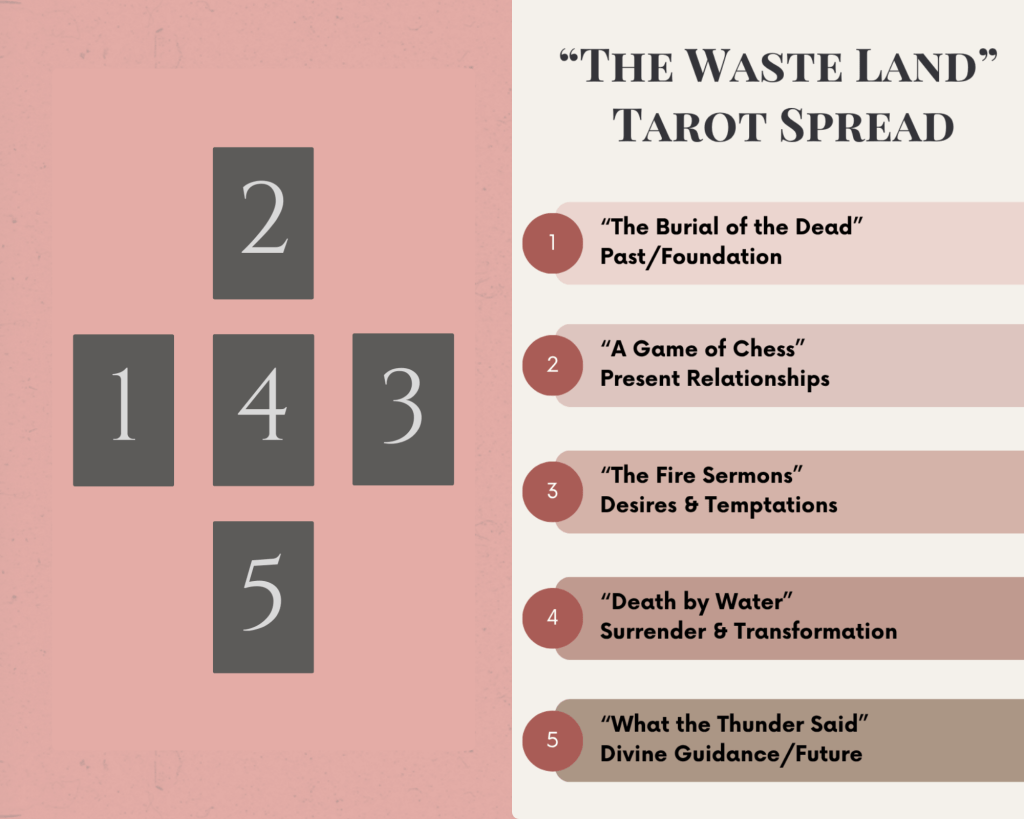
“The Waste Land” Tarot Spread
~Inspired by T.S. Eliot’s “The Waste Land”~
1. The Burial of the Dead (Past/Foundation)
“April is the cruellest month, breeding lilacs out of the dead land…”
What from your past needs to be acknowledged or laid to rest? What foundation shapes your current situation?
2. A Game of Chess (Present Relationships)
“The Chair she sat in, like a burnished throne…”
What dynamics in your current relationships need attention? How do you communicate with others?
3. The Fire Sermon (Desires & Temptations)
“Burning burning burning burning…”
What desires or material attachments are consuming you? What needs to be released through purification?
4. Death by Water (Surrender & Transformation)
“Phlebas the Phoenician, a fortnight dead…”
What must you surrender to move forward? What transformation awaits if you let go?
5. What the Thunder Said (Divine Guidance/Future)
“Datta. Dayadhvam. Damyata.” (Give. Sympathize. Control.)
What wisdom does your higher self offer? What is the path toward renewal and hope?


 Sibyl's Lab of Cartomantics
Leave a comment