

Yep, it’s that time of year again. Now, Sibyl’s not really one for Judeo-Christian holidays, but she realizes that most of us occupy sociocultural spaces that bring us into contact with rarely seen friends and family right about now. And if that circle is, for any number of reasons, unfamiliar with or unwelcoming of your tarot practice, this can create a special–and less than celebratory–kind of mood.
If so, let’s assess where we are: You have a blossoming, edifying, transformational tarot practice that occupies a meaningful space in your mind and routine. But there’s a problem.
You haven’t told your family. Or maybe you’ve told some friends but not others. You’re carefully editing social media posts, hiding your deck when certain people visit, changing the subject when conversations veer too close. You’re living with one foot in the broom closet, and it’s starting to feel heavy.
The question weighs on you: Should I tell them?
You’re not worried about your open-minded friends—the ones who’d ask for a reading themselves. You’re thinking about those people. The family members who raised their eyebrows when you stopped going to church. The friends who pride themselves on being “rational” and might see tarot as evidence you’ve lost your critical thinking skills. The relatives whose religious beliefs might lead them to view tarot as dangerous or even evil.
This is one of the most common dilemmas facing tarot readers today, and there’s no one-size-fits-all answer. What I can offer is a framework for thinking through this decision, practical guidance for navigating these conversations if you choose to have them, and—most importantly—permission to trust yourself.
Here’s what to know right from the start: Whatever you decide is okay. You’re not a coward if you choose privacy. You’re not reckless if you choose openness. You’re simply a person navigating the complex terrain of being yourself in a world that doesn’t always make that easy.
Let’s explore this together. (And while we do that, enjoy some gorgeous photos of the aptly named Tarot of Secrets.)
Before we even get to the “when,” let’s address something fundamental: You don’t owe everyone access to all parts of your life.
Your tarot practice is yours. It’s personal. It’s sacred, if you want it to be. And you get to decide who has the privilege of knowing about it.



Privacy vs. Secrecy, and Protecting Your Peace
There’s an important distinction here that often gets muddled. Secrecy involves hiding something because of shame or fear—it feels heavy and isolating. Privacy is a healthy boundary. It’s choosing what you share based on trust and safety. If you’re not telling your judgmental aunt about your tarot practice, that’s not secrecy—that’s wisdom.
You might feel torn between two valid needs: protecting your peace and living authentically. On one hand, hiding your practice can feel draining, like you’re performing a more palatable but less true version of yourself. On the other hand, telling certain people might mean arguments, lectures, or strained relationships.
Here’s what matters: The goal isn’t to achieve perfect authenticity with everyone. We all present different facets of ourselves to different people—that’s not being fake, that’s being human. The goal is finding a balance where you’re not carrying crushing hidden weight, but you’re also not exposing vulnerable parts of yourself to people who can’t handle them with care.
Questions to Ask Yourself
Before deciding whether to tell someone, consider:
1. Why do I want to tell them? Are you hoping for acceptance, tired of hiding, or wanting to share joy? Or are you hoping to change their mind or prove something? Understanding your motivation helps you assess whether telling them will actually meet that need.
2. What’s the best and worst-case scenario? Can you handle the worst case—anger, fear, judgment, or attempts to “save” you? Do you have the emotional resources for that outcome?
3. What will I lose either way? If you don’t tell them, you might lose some authenticity in the relationship. If you do, you might lose peace or the relationship as it currently exists. Which loss feels more manageable?
4. Is this relationship worth the risk? Your relationship with your mother might be worth difficult conversations. A distant cousin you see once a year? Maybe not. You get to prioritize.
5. Am I in a position of safety? If telling family could cost you housing, financial support, or education, this isn’t about emotional comfort—it’s about survival. There’s no shame in prioritizing material security. Your practice will wait for you.



Permission to Choose Privacy
It’s okay to never tell certain people. You can maintain pleasant relationships without giving everyone access to the deeper parts of who you are. That’s not being fake—that’s understanding that intimacy is a gift you give to people who’ve shown they can receive it well.
Your tarot practice can be something you share with close friends, your spiritual community, online circles—people who get it. Everyone else can know the other parts of you, the parts easier for them to accept.
There’s freedom in accepting you don’t need everyone’s approval. Some people will never get it, and that’s okay. You can love them, maintain relationships with them, and still keep this part of your life private.
The “When” Question: Timing Your Disclosure
Before having a full conversation about your tarot practice, test the waters with these subtle approaches:
Bring up tarot casually. Mention seeing a tarot reader at a festival or that a friend got a reading. Their response—immediate shutdown, curiosity, or sharing opinions—tells you plenty.
Discuss related topics. Bring up astrology, meditation, or therapy. If they’re dismissive of all introspection or anything non-materialist, that signals how they’ll likely respond to tarot.
Share something else outside their comfort zone. It doesn’t have to be spiritual—just an opinion or interest they might not understand. Do they respond with curiosity and respect, or judgment and dismissal?
Notice how they talk about others. When people in their life make choices they don’t understand, can they respect differences, or do they need conformity? This predicts how they’ll respond to you.
These small tests provide valuable information without requiring full exposure before you’re ready.



Practical Tips for Framing the Conversation
Lead with what it means to you. Instead of “I read tarot cards,” start with “I’ve found a practice that helps me with self-reflection and decision-making.”
Use language they can relate to. Frame it in terms they understand—as psychological insight, meditation, or a decision-making framework.
Be matter-of-fact. Don’t apologize or act like you’re confessing something shameful. Your energy sets the tone.
Anticipate their specific concerns. If they’ll worry you’re being scammed, mention you’re not spending money recklessly. If they have religious concerns, explain how you understand tarot in a way that aligns with your values.
Share what you’re comfortable sharing, and no more. “I’ve been reading tarot for about a year, and it’s become meaningful to me” is complete. You don’t owe them more.
Setting Boundaries
Know your boundaries before the conversation and be prepared to enforce them.
Decide what you’re willing to discuss. Are you open to questions? Willing to explain how tarot works? Would you rather just state it and move on?
Decide what you won’t tolerate. Mockery? Lectures? Attempts to change your mind? Know your line and be ready to end the conversation if it’s crossed.
Use clear boundary statements:
- “I’m sharing this because you’re important to me, but I’m not looking for advice or trying to convince you.”
- “I’m happy to answer a few questions, but I’m not going to debate this.”
- “I understand you have concerns, but this is my decision, and I need you to respect it.”
- “I can see this is upsetting you. We don’t have to talk about this further.”
Be prepared to redirect or leave. If the conversation goes somewhere uncomfortable, change the subject. If it becomes hostile or overwhelming, you can leave. “I can see we’re not going to agree on this. I’m going to go.” Then go.
Redirect and enforce boundaries. Change the subject when conversations go somewhere you don’t want. If you’ve said you won’t discuss tarot and they persist, enforce that boundary every time. End the conversation if needed.
Don’t try to convince them. You won’t change their mind through arguing or defending. Save your energy—you don’t need their approval.
Find support elsewhere. Make sure you have people who understand and support your practice. You need that validation.
Practice compassion and reassess periodically. Have compassion for their limitations and your need for acceptance. Check in with yourself regularly about whether the relationship still serves you and whether your boundaries need adjusting.



When the Relationship Can’t Be Saved
If someone won’t respect your boundaries, continues to criticize or control you, and the relationship becomes more painful than nourishing, you might need to let it go. This doesn’t mean you’ve failed—it means you’ve prioritized your wellbeing. Grieve if you need to, seek support, and know that choosing yourself is never wrong.
Your answer might be telling everyone, being selectively open, keeping your practice private for now, or testing the waters slowly. All of these are valid.
What matters is making a conscious choice rather than acting from fear or pressure. What matters is honoring both your need for authenticity and your need for safety.
Your tarot practice belongs to you. No one else gets to dictate how you engage with it or who you share it with. That’s your choice, and you get to make it over and over again as your life evolves.
So take a deep breath. Pull a card if you need to. Sit with the question. Then trust yourself to know what’s right.
You are not your tarot practice. You’re a whole, complex, valuable person, and tarot is just one part of who you are. Some people will see and accept all of you—those are your people. Some will only accept parts of you, and you get to decide whether that’s enough.
You don’t need everyone’s approval or understanding. You just need your own integrity, clarity, and commitment to living authentically.
The cards will be there for you no matter what you decide. Your practice will continue to grow. Your intuition will continue to guide you. And you will continue to become more fully yourself, one choice at a time.
Trust the process. Trust yourself. And know that whatever you decide, you’re not alone. There’s a whole community of readers who understand this struggle and are cheering you on.
You’ve got this. The cards told me so.
The Broom Closet Tarot Spread
If you’re still uncertain about whether to tell someone about your tarot practice, let the cards guide you. This seven-card spread is designed specifically for this question.
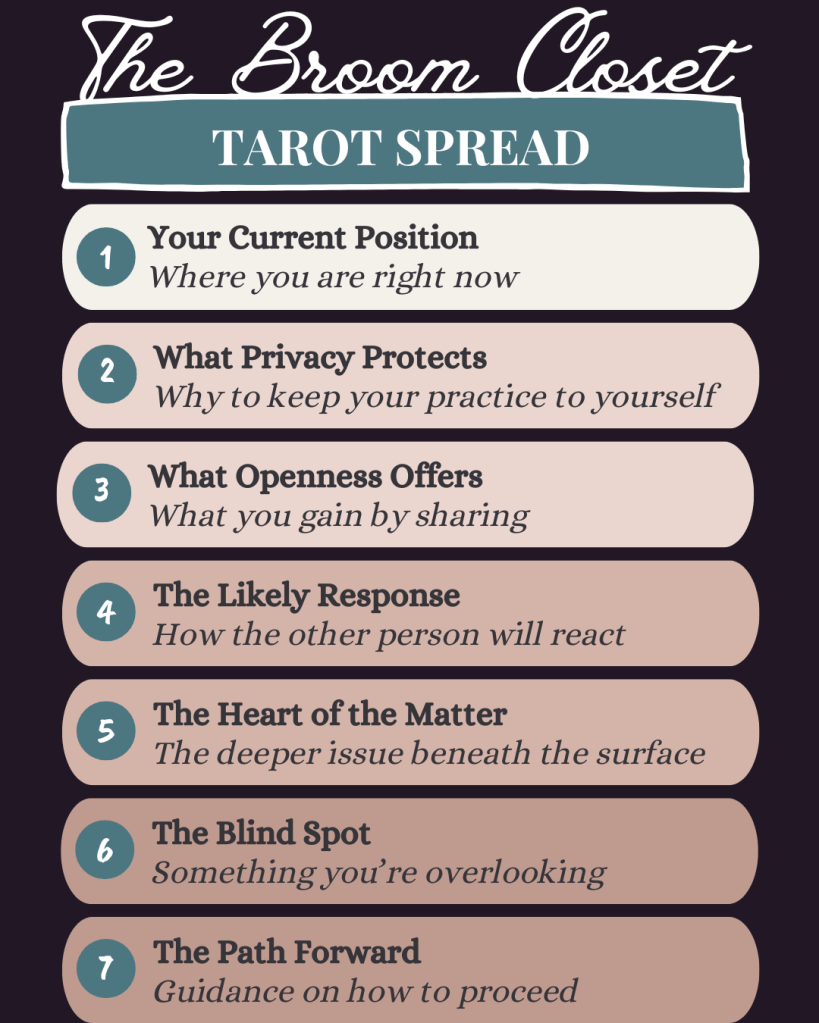
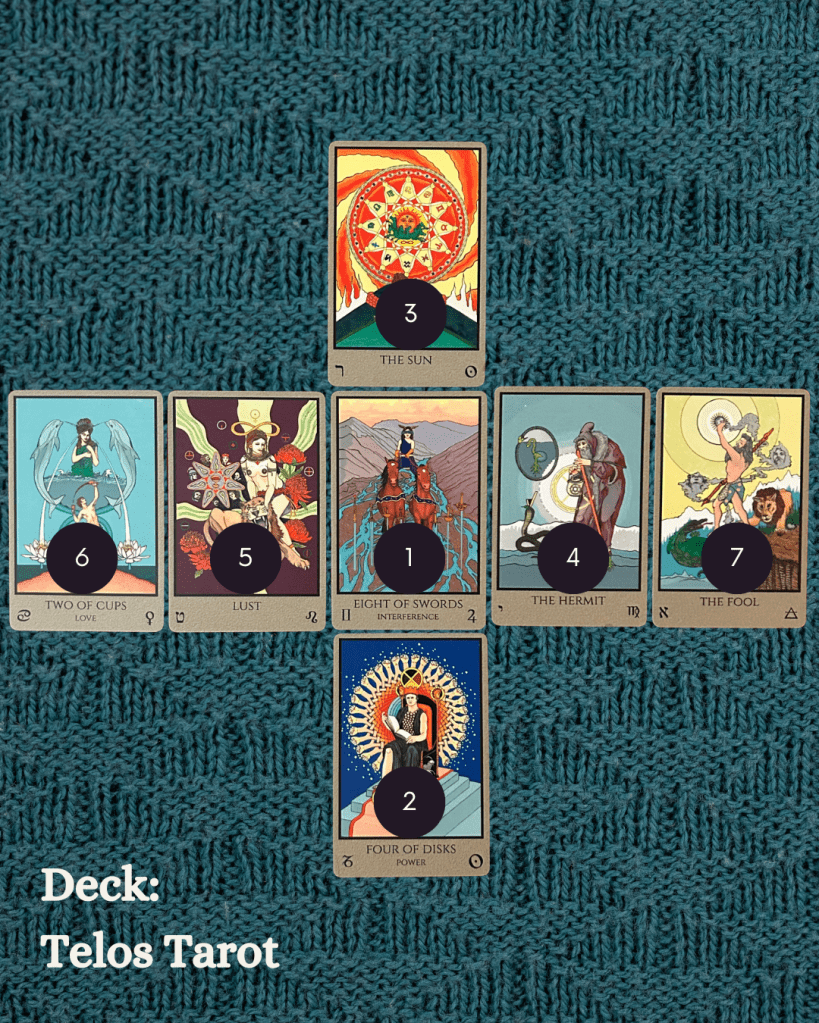
You can use this spread to explore whether to tell one particular person, or you can repeat it for different relationships to compare the guidance you receive for each one.
Card 1: Your Current Position
This represents where you are right now—your feelings, fears, and desires around this decision.
Card 2: What Privacy Protects
This card shows what you preserve by keeping your practice private. It might reveal safety, peace, or the ability to avoid conflict.
Card 3: What Openness Offers
This card reveals what you might gain by being open—authenticity, deeper connection, or freedom from hiding.
Card 4: The Likely Response
This card suggests how the person might react if you tell them. Remember, this isn’t set in stone, but it offers insight into probable outcomes.
Card 5: The Heart of the Matter
This card reveals the deeper issue beneath the surface question. What is this decision really about for you?
Card 6: The Blind Spot
This card points to something important you might be overlooking. A factor you haven’t weighed, a perspective you haven’t considered, a truth you’ve been avoiding. Pay close attention to this one.
Card 7: The Path Forward
This card offers guidance on how to proceed. It might suggest action or patience, courage or caution. It might point toward a particular approach or timing. This is the card that helps you make your decision.

 Sibyl's Lab of Cartomantics
Leave a comment