We’re slinging cards in dark times, friends. This is the second of two posts exploring precisely this, excavating dystopian themes using tarot and oracle. Although the conversation continued on YouTube, with some sample decks in tow for the journey, there is more to share.
If you want a justification for the urgency of these themes, check the aforementioned post and video—although, if you’ve found your way here, chances are that you’re also feeling a bit “end times” these days. This isn’t the divination version of recent #RaptureTok shenanigans, but an acknowledgement of the prevailing dark mood of the moment. In the spirit of showing rather than telling, continue reading for two tarot spreads, interpretive strategies, and journal prompts. After all, your own laying out of the cards will be the greatest evidence of how these themes are imprinting—or not—on your current lived experience.
The Dystopian Disruption Timeline Spread
This five-card spread helps you explore how a dystopian situation develops over time.
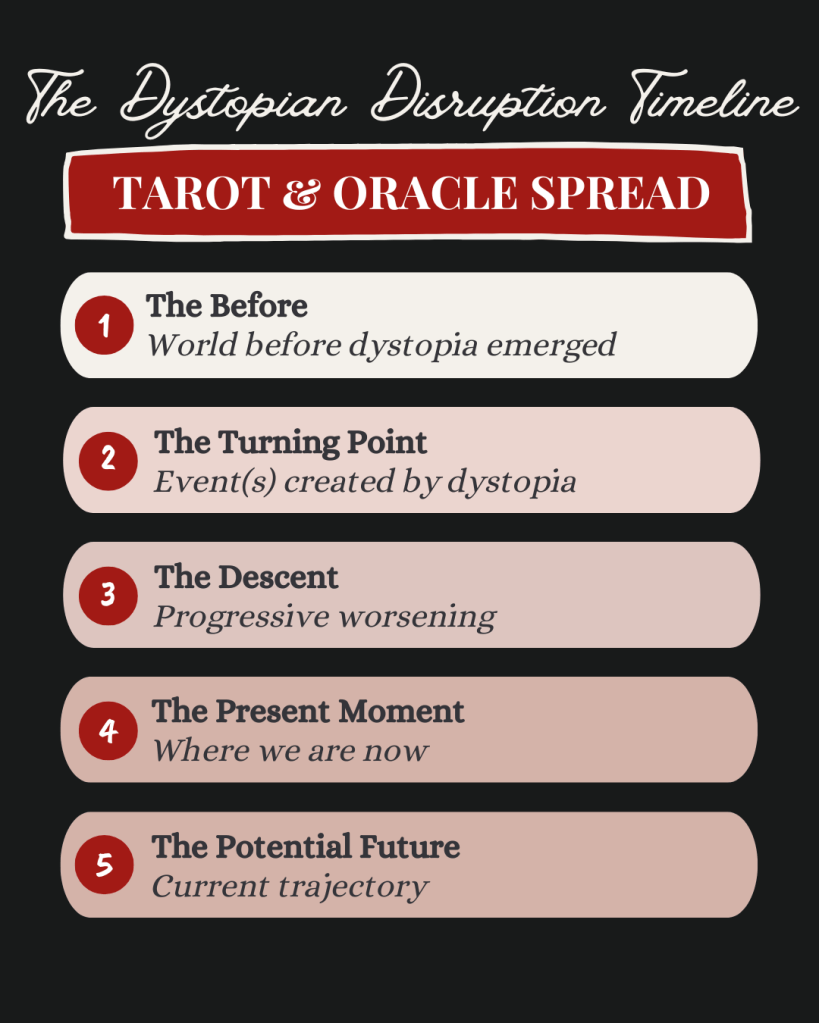
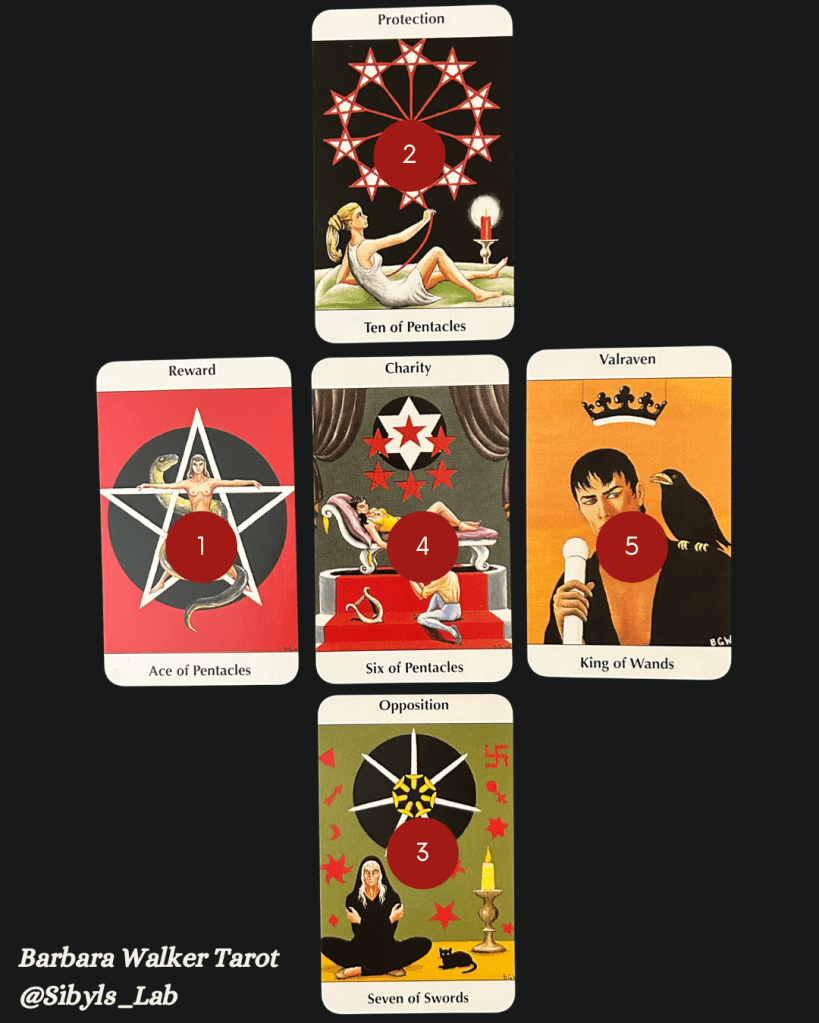
Position 1 – The Before: What was the world like before the dystopian conditions emerged?
Position 2 – The Turning Point: What event or series of events created the dystopian reality?
Position 3 – The Descent: How did things progressively worsen?
Position 4 – The Present Moment: Where are we now in this timeline?
Position 5 – The Potential Future: Where might this trajectory lead?
This spread is excellent for understanding the gradual erosion of freedoms and the incremental changes that lead to dystopian conditions—a reminder that dystopias rarely appear overnight but develop through a series of compromises and normalized oppressions.
The Rebellion & Resistance Spread
For exploring themes of rebellion, underground movements, and resistance.
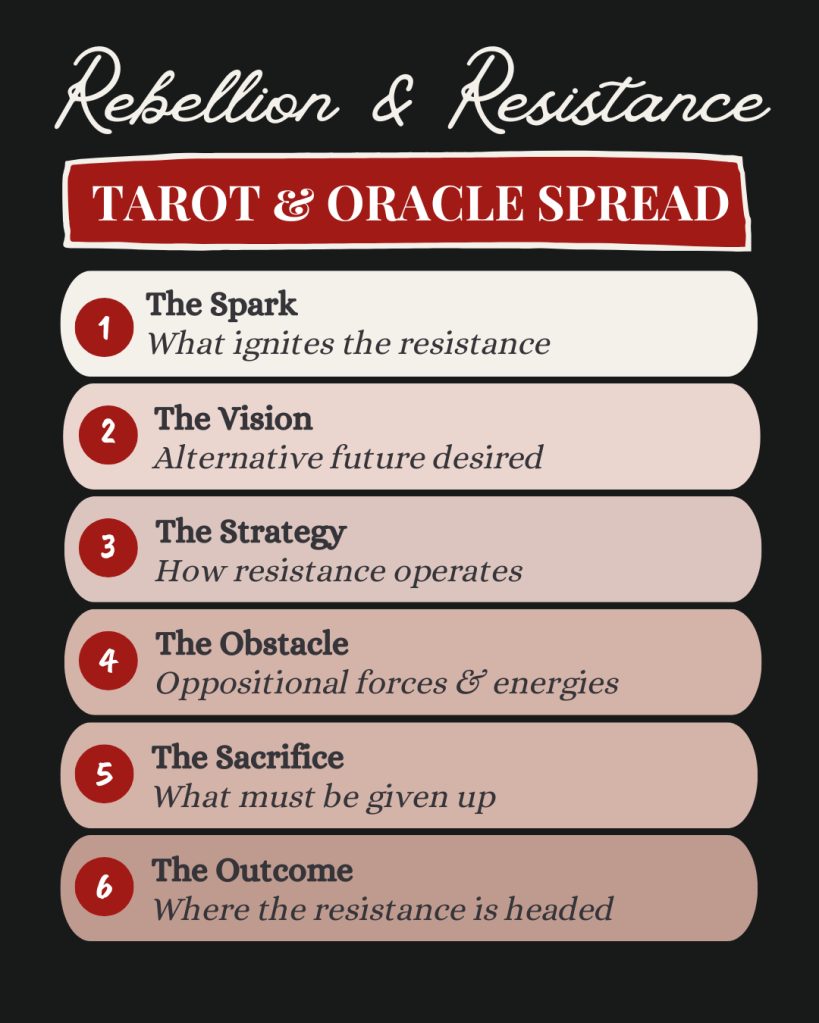

Position 1 – The Spark: What ignites the resistance?
Position 2 – The Vision: What alternative future does the resistance fight for?
Position 3 – The Strategy: How does the resistance operate?
Position 4 – The Obstacle: What stands in the way of success?
Position 5 – The Sacrifice: What must be given up for the cause?
Position 6 – The Outcome: Where is this resistance headed?
This spread can help you explore the complex ethics of resistance, the costs of fighting oppression, and the question of whether the ends justify the means—common moral dilemmas in dystopian narratives.
Special Tips for Dystopian Tarot Spreads
Elemental Analysis
Notice which elements (Fire/Wands, Water/Cups, Air/Swords, Earth/Pentacles) dominate your dystopian readings. A spread heavy in Swords might suggest a dystopia focused on information control, surveillance, and psychological oppression. Lots of Pentacles might indicate economic dystopia and resource scarcity. Predominantly Cups could point to emotional manipulation or the suppression of human connection. Many Wands might suggest a world of constant conflict and competition.
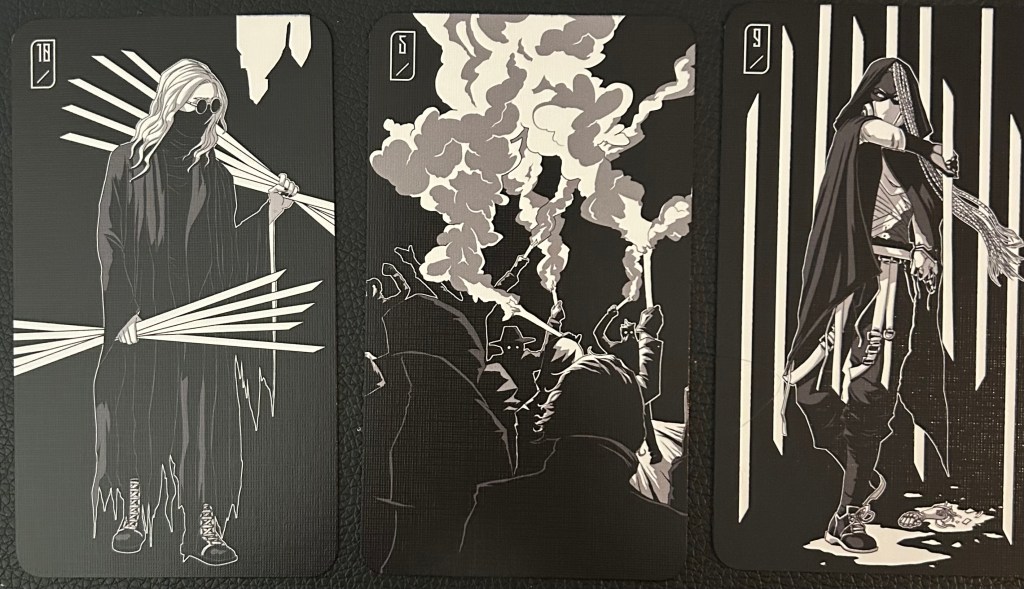
This elemental analysis can help you understand what type of dystopian scenario you’re most drawn to or concerned about.
Court Cards as Dystopian Archetypes
The Court Cards can represent different roles people play in dystopian societies:
- Pages might be the youth indoctrinated into the system or the messengers carrying information for the resistance
- Knights could be enforcers, rebels, or those taking action for or against the regime
- Queens might represent those who wield power through emotional intelligence, manipulation, or nurturing (whether for good or ill)
- Kings often embody established authority, whether tyrannical or benevolent
When Court Cards appear in your dystopian readings, consider what role or archetype they represent and how that person navigates the dystopian landscape.
Journal Prompts for Dystopian Exploration
While tarot provides symbolic insights and intuitive guidance, journaling allows you to process these insights intellectually and emotionally. The following prompts are designed to work in conjunction with tarot readings, though they can also stand alone as tools for engaging with dystopian themes.
On Surveillance and Privacy:
After pulling cards about surveillance themes, write about: What aspects of your life are already under surveillance? How do you feel about the trade-offs between convenience and privacy in your daily life? When you use social media, smart devices, or other technologies, what information are you surrendering, and to whom? If you lived in a total surveillance state, what parts of yourself would you try to keep hidden? What would you lose if you had no privacy at all?
Consider the cards you pulled. If you drew The Moon, perhaps you’re already living with more deception and hidden observation than you realize. If you pulled the Eight of Swords, you might feel trapped by surveillance systems you can’t escape. Let the cards guide your reflection on these questions.
On Conformity and Individuality:
Reflect on: What pressures do you face to conform in your daily life? What aspects of your identity or beliefs do you hide or modify to fit in? When have you chosen comfort or safety over authenticity? What would you be willing to sacrifice to maintain your individuality? In what ways do you already self-censor?
If your tarot reading included cards like The Hierophant or the Four of Pentacles, explore what these cards reveal about your relationship with conformity and the institutions that shape your behavior.
On Complicity and Resistance:
Journal about: In what ways are you complicit in systems you know are unjust? What injustices do you witness but fail to challenge? What would it take for you to actively resist rather than passively accept? What fears keep you from speaking out or taking action? What small acts of resistance are available to you?
Cards like The Devil might point to ways you’re trapped in complicity, while cards like Strength or the Seven of Wands might reveal your capacity for resistance.
On Truth and Propaganda:
Write about: How do you determine what’s true in an age of misinformation? What sources of information do you trust, and why? Have you ever believed something that turned out to be propaganda or manipulation? How do you distinguish between legitimate persuasion and manipulation? What would you do if you discovered that a fundamental belief you held was based on lies?
The Moon, the Magician, or the High Priestess in your reading might offer insights into your relationship with truth and deception.
On Environmental Collapse:
Reflect on: What signs of environmental dystopia do you already see in the world? How do you cope with climate anxiety or eco-grief? What changes have you made or are you willing to make to address environmental issues? What do you imagine life will be like for future generations? How do you balance hope and despair when thinking about environmental futures?
Cards from the Suit of Pentacles, or Major Arcana cards like The World or The Tower, can provide frameworks for processing these heavy questions.
Remember to Balance Darkness & Light
While dystopian exploration can be valuable, don’t let it consume you. Balance your dystopian tarot work with readings and journaling about hope, resilience, beauty, and possibility. For every session exploring oppression, consider doing one exploring liberation or joy.
Conclusion: The Power of Symbolic Exploration
Working with tarot and journal prompts to explore dystopian themes offers a unique and powerful way to engage with one of literature’s most important genres. Dystopian fiction serves as a warning, a mirror, and a call to action—it shows us possible futures we want to avoid and asks us to examine the seeds of those futures already present in our world.
Tarot provides a symbolic language that helps us access intuitive understanding of these complex themes. The cards offer archetypal images that resonate with dystopian concepts—oppression, resistance, surveillance, collapse, transformation, and hope. They create a bridge between the abstract ideas in dystopian fiction and our lived experiences, helping us see how these themes play out in our own lives and societies.
Journaling transforms the symbolic insights from tarot into conscious understanding. It allows us to process difficult emotions, develop complex ideas, create compelling characters and worlds, and integrate our learning into actionable awareness. The combination of tarot’s intuitive wisdom and journaling’s analytical depth creates a practice that engages both heart and mind.
Whether you’re a writer crafting dystopian narratives, a reader wanting to engage more deeply with the genre, or simply someone concerned about the direction of contemporary society, this practice offers valuable tools for exploration and understanding. It helps you think more critically about power, freedom, technology, and human nature. It challenges you to examine your own complicity and capacity for resistance. It invites you to imagine both the worst possibilities and the paths toward better futures.
As you develop your practice of working with tarot and dystopian themes, remember to balance darkness with light, to care for your emotional well-being, and to channel your insights into meaningful action. Dystopian fiction warns us about possible futures precisely so we can work to prevent them. Let your tarot readings and journal entries not just deepen your understanding but also inspire your choices and actions in the real world.
The cards are tools for seeing more clearly. The journal is a space for thinking more deeply. Together, they can help you navigate the dystopian elements already present in our world and work toward futures that honor human dignity, freedom, and flourishing. In times that often feel dystopian, this kind of reflective practice isn’t just creative or analytical—it’s essential for maintaining awareness, agency, and hope.
May your explorations be insightful, your writing be powerful, and your actions be meaningful. The future is not yet written, and every reading, every journal entry, every moment of awareness is an act of resistance against the dystopias we fear and a step toward the worlds we hope to create.

 Sibyl's Lab of Cartomantics
Leave a comment