As the season of monstrosity continues, we have a second musing on this theme, contemplating the journey to integrating the grotesque, gruesome, dreadful image we find in the mirror. (You can find the first pass here.
This week, we specifically invite myth to function as that mirror. What breadth of god and goddess archetypes support an embrace of inner darkness? I’ve mused elsewhere on two such goddesses: Medusa (in writing) as well as the Morrigan (in video). But there are any number of cross-pantheon choices. As we discover a handful of them, you can also expect a list of journaling prompts and a short spread to provide a foundation for your personal work moving forward.
Theology of the Holy Shadow
Many spiritual traditions, despite their rhetorical emphasis on transcendence and purity, contain profound wisdom regarding the totality of human nature. In Tibetan Buddhism, wrathful deities with terrifying visages and multiple arms represent not malevolence, but the fierce compassion required to sever delusion. They embody the recognition that destruction is sometimes prerequisite to transformation.
The Hindu goddess Kali, adorned with a garland of skulls and tongue stained with blood, represents the destructive aspect of the divine feminine. She annihilates ego, illusion, and ignorance. To honor Kali is to acknowledge that creation and destruction are inextricable—that new life emerges from death, and that our own psychological and spiritual rebirth necessitates the death of false selves.
In Christian mysticism, the “dark night of the soul” described by St. John of the Cross involves a descent into spiritual desolation wherein all consolations are stripped away. This darkness is not to be circumvented but embraced as essential passage toward deeper union with the divine. The monster we encounter in this darkness is frequently ourselves—our attachments, our pride, our compulsive need for control.
To spiritually embrace our monstrosity is to recognize that we are not meant for angelic existence. We are embodied beings with animal instincts, tribal allegiances, and survival mechanisms that can manifest as violence, acquisitiveness, and tribalism. Denying this does not elevate our spiritual status; it renders us more dangerous, for we then act from unconscious motivations we refuse to examine.
Deities for Sacred Monstrosity
For those drawn to engaging with divine archetypes in their shadow integration work, certain deities across traditions embody the wisdom of embracing monstrosity. These are not domesticated, sanitized figures but potent forces that hold space for the full spectrum of human experience.
Hecate (Greek) – Goddess of crossroads, witchcraft, and liminal spaces between worlds. She guides travelers through darkness and presides over the threshold between conscious and unconscious realms. Working with Hecate entails confronting what lurks at the periphery of our awareness and discovering power in the territories we have been conditioned to fear.
Lilith (Jewish/Mesopotamian) – The first wife of Adam who refused submission and was subsequently demonized for her autonomy. She represents the rage of women who have been silenced, the sexuality that has been shamed, and the power inherent in refusing self-diminishment. Lilith teaches that what dominant culture designates as monstrous may simply be authentic.
Set (Egyptian) – God of chaos, storms, and desert wilderness. Vilified in later Egyptian mythology, Set originally represented necessary disorder and the wild forces that resist domestication. He embodies those aspects of ourselves that resist socialization and the destructive energy that occasionally clears the way for new growth.
The Morrigan (Celtic) – Phantom queen and goddess of war, death, and sovereignty. She manifests as a crow on battlefields and prophesies doom, yet also confers victory and transformation. The Morrigan does not recoil from violence or endings—she facilitates the deaths we must undergo to become who we are meant to be.

Dionysus (Greek) – God of wine, ecstasy, and divine madness. Beneath the veneer of revelry lies a deity of dissolution and transformation who dismantles rigid structures, including the rigid structures of ego. Dionysus offers liberation through temporary loss of control and the embrace of our instinctual, ecstatic nature.
Sekhmet (Egyptian) – Lion-headed goddess of war and healing. Her rage nearly annihilated humanity until she was deceived into cessation. She represents the razor-thin boundary between destruction and protection, demonstrating that our most ferocious, most dangerous qualities can be redirected toward healing and defense of what matters.
Loki (Norse) – Trickster god who defies categorization and transgresses boundaries. Neither fully god nor giant, neither wholly benevolent nor malevolent, Loki embodies the shapeshifting nature of the shadow and the creative chaos born of refusing conformity. Working with Loki means embracing contradiction and discovering wisdom in disruption.
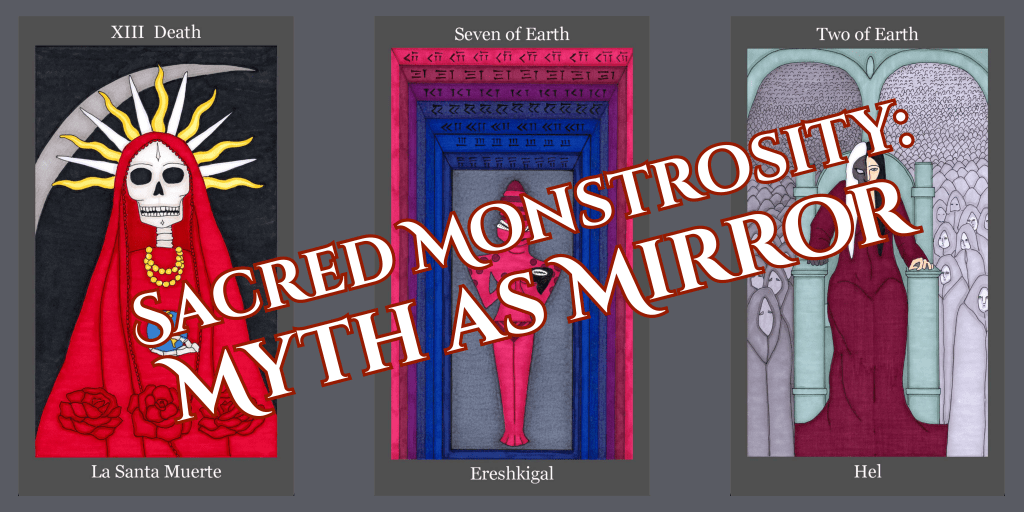
Ereshkigal (Mesopotamian) – Queen of the underworld and goddess of death. When her sister Inanna descends to visit her realm, Ereshkigal strips her of everything and kills her. She represents the dark feminine that has been exiled, the grief and rage that dwells in the depths, and the transformative power of complete surrender to forces beyond our control.
Shiva (Hindu) – The destroyer within the Hindu trinity, who dances the cosmos into and out of existence. Shiva’s destructive aspect is not malevolent but necessary—he destroys ignorance, ego, and illusion. His third eye incinerates what is false, leaving only truth, however uncomfortable.
Santa Muerte (Mexican Folk Catholicism) – The saint of death, embraced by those dwelling at society’s margins. She neither judges nor discriminates—she welcomes all regardless of their transgressions or status. Santa Muerte teaches acceptance of our mortality and those aspects of ourselves that respectable society rejects.
Hel (Norse) – Goddess of the underworld, depicted as half-living flesh and half-corpse. Cast out by the gods for her appearance, she rules over those who perished from illness or old age rather than in battle. Hel embodies the rejected, the unglamorous, and the inevitable decay inherent in all life.
Working with these deities does not necessitate formal religious practice. It can manifest as simply as researching their mythologies, meditating upon their attributes, creating art inspired by them, or invoking their energy during shadow work. They function as mirrors for the aspects of ourselves we have been taught to exile—and as guides for facilitating their return home.
Engaging the Ancient Shadow Journal Prompts
Mythology provides a symbolic language for understanding our internal landscapes. These prompts invite you to engage with ancient narratives as vehicles for exploring your own shadow material, using the distance of myth to approach what might otherwise remain too threatening to examine directly.
On Transformation and Metamorphosis
- In Ovid’s Metamorphoses, transformation often arrives as punishment or consequence—Arachne becomes a spider, Actaeon a stag, Medusa a gorgon. What aspect of yourself feels like it has been transformed into something monstrous as punishment? What transgression preceded this transformation? What if the monstrous form contains gifts the original form lacked?
- Circe transforms Odysseus’s men into swine, revealing their true nature through physical form. If your shadow self were to manifest as an animal, what creature would it be? What does this creature’s nature reveal about the instincts and capacities you have domesticated or denied?
- The werewolf mythology speaks to the beast that emerges under certain conditions—the full moon, a curse, an inherited bloodline. What conditions or triggers cause your shadow self to emerge? What patterns can you identify in these manifestations?
On Monsters and Heroism
- Beowulf confronts Grendel, a creature driven to rage by exclusion from the mead-hall’s warmth and community. What part of yourself has been excluded from your internal “mead-hall”? What violence or disruption does this exclusion generate? What would it mean to invite this aspect to the feast?
- Theseus navigates the labyrinth to confront the Minotaur—half-man, half-bull, product of unnatural union and shameful secret. What labyrinth must you navigate to reach your own Minotaur? What shameful secret or unnatural desire does it represent? What would it mean to confront rather than simply contain it?
- Perseus can only defeat Medusa by viewing her reflection rather than looking directly at her, lest he turn to stone. What aspects of your shadow can you only approach obliquely, through reflection or symbolic distance? What threatens to paralyze you if you look too directly?
On Divine Transgressions and Consequences
- Prometheus steals fire from the gods and suffers eternal punishment—yet his transgression enables human civilization. What forbidden knowledge or capacity have you claimed for yourself? What punishment (internal or external) have you endured for this theft? How has this transgression served your becoming?
- Inanna descends to the underworld and is stripped of everything—her crown, her jewels, her garments, finally her life—before she can be resurrected and return transformed. What descent have you undergone or are you currently undergoing? What is being stripped away? What death must you die before resurrection becomes possible?
- Persephone’s abduction into the underworld makes her simultaneously victim and queen, maiden and death goddess. What traumatic rupture in your life has forced you to claim power you would not have otherwise sought? How has violation or darkness paradoxically granted you sovereignty?
On Forbidden Knowledge and Dangerous Wisdom
- Pandora opens the forbidden box despite explicit warnings, releasing suffering into the world—yet hope remains at the bottom. What forbidden territory of your psyche have you opened despite knowing you shouldn’t? What suffering was released? What hope remains?
- Psyche betrays Eros by looking at him in lamplight, violating his condition for their union. What trust have you violated out of compulsive need to know, to see, to understand? What intimacy was destroyed by your inability to remain in mystery? What was gained through the transgression?
- Oedipus relentlessly pursues truth despite mounting evidence that knowledge will destroy him. What truth about yourself have you pursued past the point of comfort or safety? What has this knowledge cost you? Was the price worth paying?

On Duality and the Double
- Jekyll and Hyde represent the civilized self and its monstrous counterpart existing in the same body. Write a dialogue between your Jekyll and your Hyde. What does each accuse the other of? What does each secretly envy in the other? What would integration rather than alternation look like?
- The doppelgänger in folklore often portends death or misfortune—an uncanny double that represents something both familiar and terrifying. If you encountered your shadow self as an external double, what would differentiate it from your conscious self? What would it be doing that you refuse to do? How would it move through the world differently?
- Dionysus is called “the god of two minds”—simultaneously liberator and destroyer, ecstatic and mad. What internal duality do you experience as irreconcilable? What if both aspects are authentic rather than one being true and the other false?
On Curses, Legacies, and Inherited Monstrosity
- The House of Atreus suffers a multi-generational curse of violence, betrayal, and revenge. What patterns of dysfunction, trauma, or shadow material have you inherited from your family lineage? Where do you see yourself unconsciously repeating ancestral patterns? What would it mean to be the generation that breaks the curse?
- Vampirism in folklore represents a contagion passed through blood—the victim becomes the monster. What wound or trauma has transformed you into something you never wished to become? How have you found yourself perpetuating what was done to you?
- The changeling myth speaks to the fear that the child is not quite right, not quite human, secretly something other. What part of yourself has always felt like an imposter, something other wearing human skin? What if this otherness is your greatest authenticity rather than your deepest deception?
Other Prompts on Myth and Archetype
- Which deity, monster, or archetypal figure from mythology provokes the strongest reaction in you—whether attraction or repulsion? What might this figure represent about your own shadow?
- If your life were a fairy tale, what monster would the hero encounter? What would this monster demand? What transformation would occur through the confrontation?
- What stories were you told about who you should become? What alternative narratives have you been forbidden from inhabiting? What would your life look like if you authored your own mythology?
- Return to these prompts as portals into different aspects of your shadow material. The myths that evoke the strongest response—whether fascination, repulsion, or recognition—often indicate the territories most essential to your integration work. Let the ancient stories guide you through your own labyrinth.
The Monster’s Journey Tarot Spread
Select a thematically complementary deck and do the following spread as a part of your continued personal exploration of monstrosity.

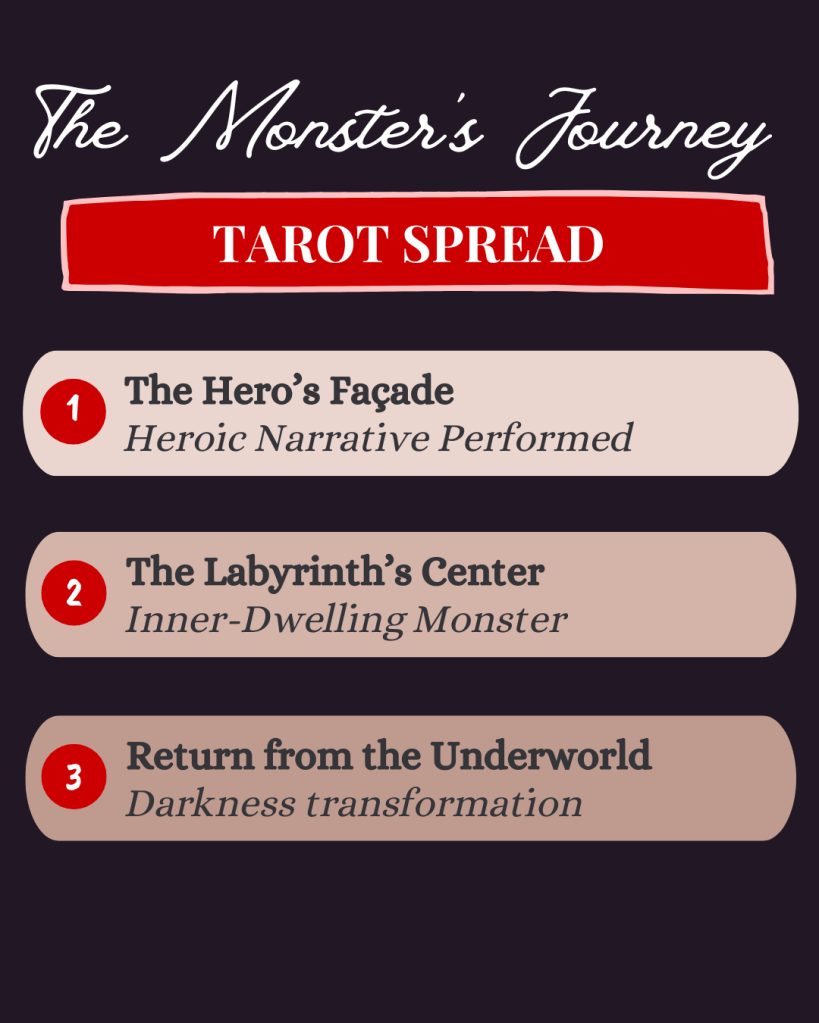
- The Hero’s Façade – What heroic narrative do I perform for the world? What quest or virtue do I display to maintain my place in the mead-hall of acceptability?
- The Labyrinth’s Center – What Minotaur dwells in my depths? What hybrid, shameful, or exiled aspect lurks in the maze I have constructed to contain it?
- Return from the Underworld – What do I bring back from the underworld? What power, wisdom, or wholeness becomes possible when hero and monster recognize each other as kin?
Journal extensively on each card’s imagery, your immediate reactions, and the uncomfortable associations that arise. Return to this spread periodically; the same positions will reveal different dimensions as your relationship with your shadow evolves, much as Inanna’s descent yielded different wisdom with each stripping away of her regalia.

 Sibyl's Lab of Cartomantics
Leave a comment