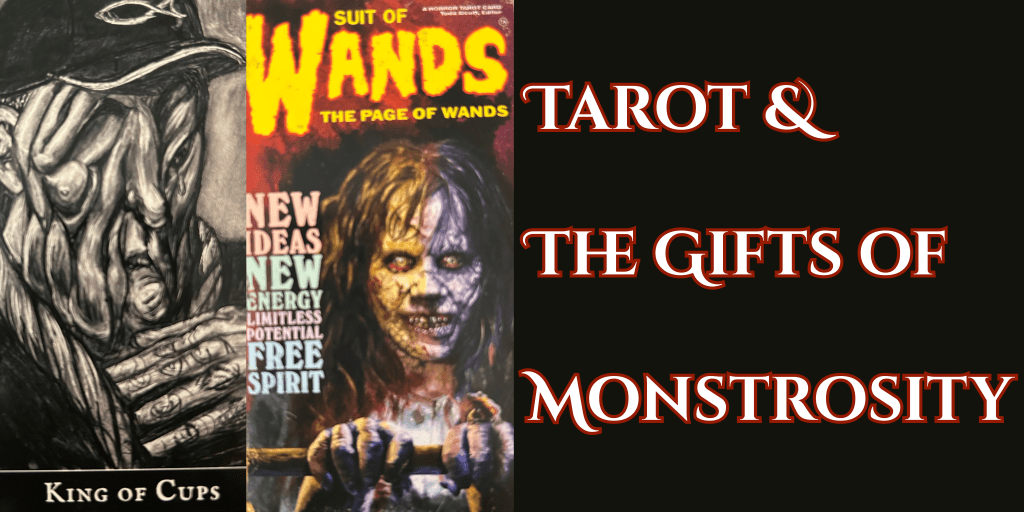
It is the season for celebrating monsters, or so the greeting cards say. And so here we are, considering the mask of the monstrous: what it is, why it serves us, and how to heal by embracing it. I’ve mused before about my own journey with my patroness Medusa, the powerful and dreadful, and also posted a video on that dark queen of warlike death and dread, the Morrigan. And yet considering how we might be dreadful—how it is, indeed, both a wound and a superpower—is a different matter altogether. So let’s begin the first half of our exploration, to be continued with an investigation of monstrosity and myth next week.
We spend the greater part of our existence cultivating–or perhaps aspiring to, or performing–virtue. We meticulously craft our digital personas, exercise restraint in moments of conflict, and actively suppress the darker impulses that emerge from our psychological depths. From childhood, we are conditioned to regard certain thoughts, feelings, and desires as impermissible—markers of moral deficiency. Yet what if this very denial of our shadow aspects perpetuates our psychological fragmentation, our anxiety, our spiritual estrangement?
To embrace our own monstrosity is not to become monstrous. It is to acknowledge, with unflinching honesty, that we contain multitudes—including those dimensions of self we have been conditioned to fear and disavow. It means recognizing that within each of us resides the capacity for cruelty, selfishness, rage, and destruction alongside our capacity for love, compassion, and creation. This is not pathology. It is the fundamental condition of human existence.
The Monster as the Disowned Self
Carl Jung articulated the concept of the shadow—those unconscious dimensions of personality that the conscious ego refuses to claim. These are the traits we have repressed because they were deemed unacceptable by our families, cultures, or societies. The shadow contains not merely negative qualities but also positive attributes we have been conditioned to suppress. A woman socialized toward demureness may repress her assertiveness. A man trained in stoicism may bury his vulnerability.
The difficulty with repression lies in its inefficacy: it does not eliminate these aspects of self. Rather, they operate unconsciously, undermining our relationships, manifesting as inexplicable anxiety, or projecting onto others. We perceive in others what we cannot tolerate in ourselves. The colleague we despise for excessive aggression may be mirroring the assertiveness we have disowned. The friend whose dependency irritates us may be reflecting our own unacknowledged needs.
Jung proposed that psychological wholeness—what he termed individuation—necessitates shadow integration. This does not suggest acting upon every dark impulse, but rather bringing these dimensions into conscious awareness where they can be examined, accepted, and transformed. When we deny our capacity for anger, we resort to passive aggression. When we acknowledge it, we can channel it toward healthy boundaries and constructive change.
The Monster as Guide and Revelator
Our inner monster is not our adversary. It is a teacher, a guide, and a reservoir of power we have been too timorous to claim. It possesses truths about us that our conscious mind has been unwilling to confront. It holds energy we have been too fearful to channel. It contains gifts we have been too ashamed to unwrap.

When we approach our monstrosity with curiosity rather than judgment, we frequently discover that what we feared was not as catastrophic as we imagined. The anger we suppressed may be righteous indignation at injustice. The selfishness we denied may be a healthy instinct for self-preservation. The darkness we rejected may be the rich soil from which our most authentic self can flourish.
In fairy tales and myths—as we’ll delve into further next week—the hero must often confront a monster, and sometimes that monster transforms into an ally or reveals itself as a misunderstood being. This is not merely narrative convention—it is psychological and spiritual truth. The monster we refuse to face haunts us. The monster we confront and comprehend becomes integrated into our wholeness.
To embrace our monstrosity is to become more fully human. It is to accept that we are not simple, not pure, not easily categorized as virtuous or malevolent. We are complex, contradictory, capable of both tremendous love and terrible harm. And in accepting this totality, we paradoxically become more capable of choosing love, for we no longer expend our energy denying half of who we are.
The path to psychological health and spiritual maturity does not circumvent the monster. It runs directly through it. And on the other side, we discover not the destruction we feared, but a more authentic, integrated, and compassionate version of ourselves—one capable of holding both light and shadow, both angel and demon, in a wholeness that is finally, genuinely human.
The Shadow Beast in Tarot
The tarot, that medieval compendium of psychological and spiritual wisdom, contains within its archetypal structure numerous figures that embody the monstrous dimensions of human experience. These cards do not represent evil but rather the uncomfortable truths, necessary destructions, and transformative darkness that conventional spirituality often seeks to transcend. To work with these archetypes—a few of which are listed below—is to engage directly with the shadow material that constitutes our disowned wholeness. The overrepresentation of the Major Arcana and Swords suit in this list is itself instructive regarding the energetic orientation of the Rider-Waite Smith Tarot.
Death (XIII) – Despite cultural conditioning that renders this card terrifying, Death represents not literal mortality but rather the psychological and spiritual deaths required for transformation. The skeleton in armor moves inexorably forward, and neither king nor peasant can negotiate with this force. Death teaches that certain aspects of self must be relinquished—the relationship that no longer serves, the identity that has become constraining, the belief system that no longer reflects our truth. The monstrosity of Death resides in its implacability and its insistence that we cannot carry everything forward into our next becoming.
The Devil (XV) – Perhaps the most explicitly monstrous card in the Major Arcana, The Devil represents not supernatural malevolence but rather our bondage to unconscious patterns, addictions, and the material realm. The chained figures beneath the demon are held not by locked shackles but by loose chains they could easily remove—a profound recognition that we are frequently complicit in our own imprisonment. The Devil illuminates our shadow attachments: the destructive relationships we refuse to leave, the substances we use to numb our pain, the beliefs that constrain our authentic becoming. He asks us to examine what we have made our master and whether our enslavement serves our evolution or arrests it.
The Tower (XVI) – This card depicts violent destruction: a tower struck by lightning, figures plummeting from its heights, the collapse of everything we believed stable. The Tower represents the necessary demolition of false structures—the ego constructions, belief systems, and identities we have mistaken for truth. Its monstrosity lies in its refusal to permit comfortable delusion. When The Tower appears, it signals that something must be destroyed for authentic growth to occur. This destruction may arrive through external crisis or internal revelation, but its purpose remains constant: to shatter what has become ossified so that genuine transformation becomes possible.
The Moon (XVIII) – This card depicts a path leading between two towers toward distant mountains, illuminated only by moonlight that distorts rather than clarifies. A crayfish emerges from the unconscious waters while a dog and wolf howl at the deceptive lunar face. The Moon represents the territory of shadow, illusion, and the unconscious—where nothing is quite what it appears and where we must navigate by instinct rather than reason. Its monstrosity is subtle: the fear that arises when we cannot trust our perceptions, the anxiety of not knowing what lurks in the darkness, the confrontation with aspects of psyche that operate beyond rational control.
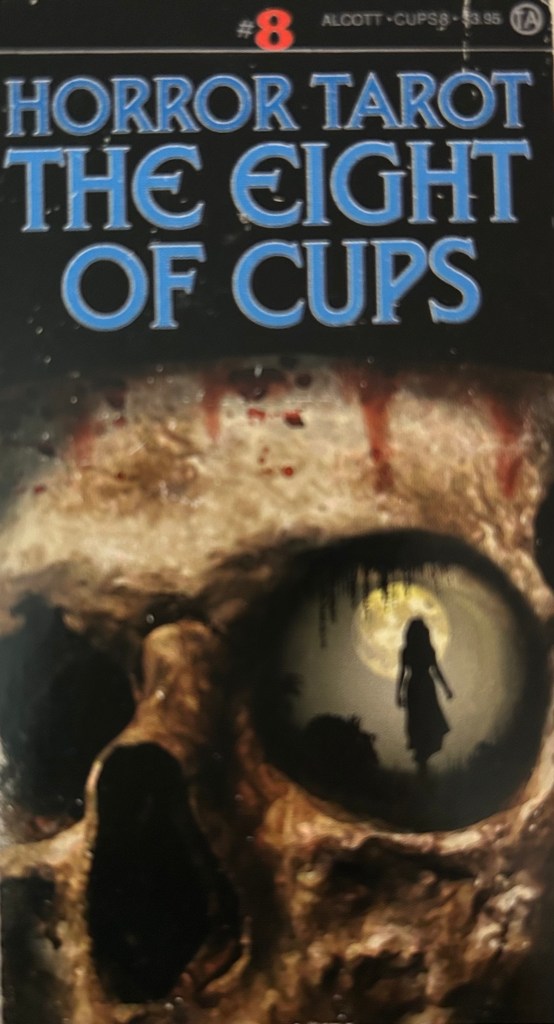
Three of Swords – The image of a heart pierced by three swords represents heartbreak, betrayal, and emotional devastation. This card asks us to confront our capacity both to wound and to be wounded—to acknowledge the times we have betrayed others and the grief we carry from our own betrayals. The Three of Swords does not offer comfort but rather demands that we face emotional pain directly rather than spiritually bypassing it through premature forgiveness or false transcendence.
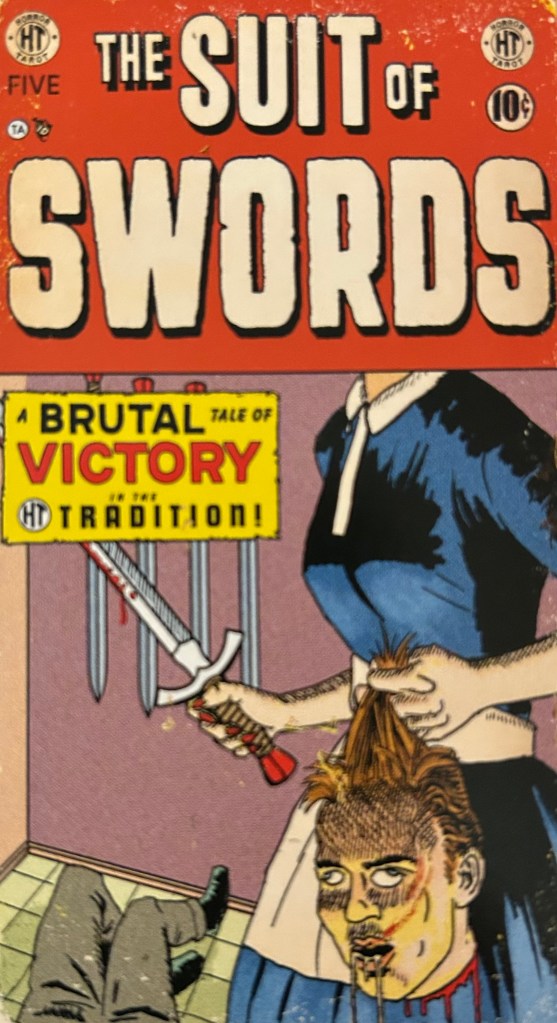
Five of Swords – In the Minor Arcana, this card frequently depicts a figure who has won a battle through questionable means, standing among defeated opponents with an expression of hollow victory. The Five of Swords represents the shadow aspects of competition, conflict, and self-interest—the times we have chosen winning over integrity, or witnessed the pyrrhic nature of victories achieved through cruelty. It asks us to examine our relationship with power, our capacity for ruthlessness, and the ways we justify harm in pursuit of our objectives.
Seven of Swords – Often illustrated as a figure sneaking away with stolen swords, this card embodies deception, strategy, and the shadow aspects of cunning. It represents the parts of ourselves that manipulate, withhold truth, or operate through subterfuge. The Seven of Swords does not simply condemn these qualities but asks us to examine them: When have we employed deception? What were we protecting or pursuing? How might our strategic intelligence serve us consciously rather than operating through unconscious manipulation?
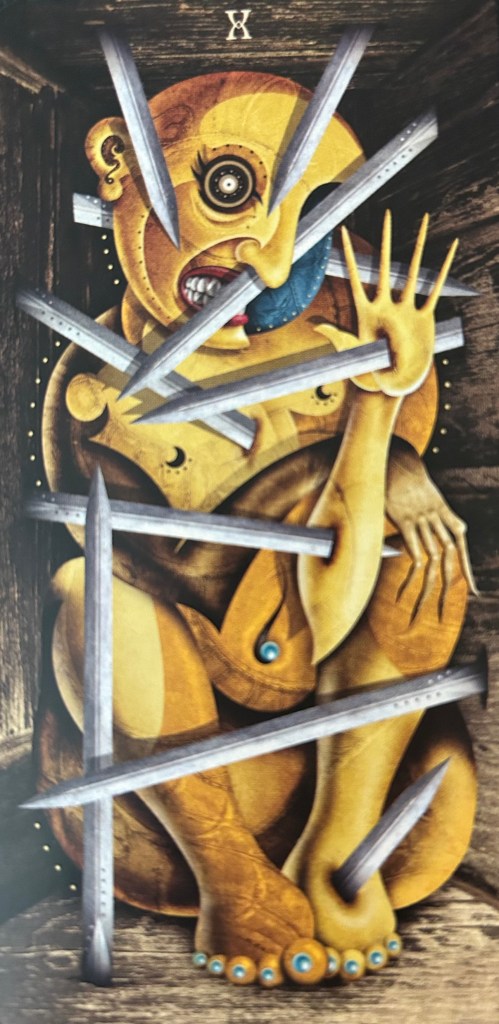
Ten of Swords – This card typically depicts a figure face-down with ten swords embedded in their back—a image of utter defeat, betrayal, and the painful ending of a cycle. Its monstrosity lies in its totality: there is no ambiguity here, no possibility of revival. The Ten of Swords represents the moment when we must acknowledge complete failure, devastating betrayal, or the absolute conclusion of something we wished to preserve. Yet embedded within this apparent catastrophe lies liberation—the recognition that when something is utterly finished, we are finally free to begin anew.
The Shadow Court Cards – Within each suit, certain court cards carry particular shadow resonance. The King of Swords can represent cold rationality divorced from compassion, the intellectual tyrant who wields logic as a weapon. The Queen of Cups reversed embodies emotional manipulation and the distorted feminine that uses sensitivity as a tool of control. The Knight of Wands may manifest as reckless aggression and the destructive masculine that charges forward without consideration of consequences. These figures remind us that every strength, taken to excess or divorced from its balancing opposite, becomes monstrous.
Working with these archetypes in shadow integration can take multiple forms: meditating upon the cards, journaling about their appearance in readings, or consciously invoking their energy when confronting parallel internal dynamics. These are not cards to fear but rather allies in the work of becoming whole—teachers who refuse to permit the comfortable delusions that fragment our authenticity. They remind us that the tarot, like all genuine spiritual technologies, does not exist to make us feel better but to make us more real.
Meeting the Tarot Monster: Journaling Prompts
Tarot functions not as divination but as a symbolic technology for accessing unconscious material. These prompts use specific cards as frameworks for exploring your relationship with your own monstrosity. You need not perform formal readings; instead, pull the designated card from your deck, study its imagery, and use it as a contemplative anchor for the questions that follow.
Working with Death (XIII)
Pull Death and observe the inevitability in the skeletal figure’s movement.
- What aspect of your current identity is ready to die? What version of yourself are you clinging to past its expiration? What relationship, belief, or self-concept must you grieve and release?
- Death makes no distinctions between king and peasant, beloved and stranger. What are you trying to exempt from necessary ending through privilege, denial, or negotiation? What makes you believe you should be the exception?
- What resurrection might become possible if you stopped resisting a particular death? What new self is waiting to be born on the other side of what you refuse to let go?
6 of Swords

7 of Wands

10 of Wands
Working with The Devil (XV)
Pull The Devil card and place it before you. Examine the chained figures beneath the horned deity.
- What chains bind you that you could, in theory, remove at any moment? What addictions, compulsive patterns, or toxic attachments do you maintain despite their evident harm?
- The Devil represents our shadow’s sovereignty over us when we refuse conscious engagement. Where in your life are you being ruled by unconscious impulses—spending, sexual behavior, rage, substance use, relationship patterns—that you rationalize rather than examine?
- What would you have to sacrifice or confront to remove your chains? What identity or comfort would you lose? Is your bondage serving some hidden purpose?
Working with The Tower (XVI)
Pull The Tower and contemplate the figures falling from the collapsing structure.
- What belief system, identity structure, or false security in your life is ready to collapse? What are you desperately trying to keep standing that, truthfully, serves your evolution to demolish?
- Recall a Tower moment in your past—a devastating rupture that destroyed something you believed permanent. What false self died in that destruction? What authentic self was revealed in the rubble?
- What would it mean to willingly become the lightning bolt rather than the tower—to consciously destroy what is ready to fall rather than waiting for crisis to do it for you?
Working with The Moon (XVIII)
Pull The Moon and study the path winding between the towers into uncertainty.
- The Moon illuminates distortion rather than clarity. What deception are you currently operating under—about yourself, your relationships, your circumstances? What convenient illusion would you rather maintain than confront?
- What emerges when you venture into your own unconscious territory? What creatures from your psychological depths appear in dreams, intrusive thoughts, or patterns you cannot rationally explain?
- The dog and wolf howl at the Moon—the domesticated and wild aspects of self responding to the same call. What tension exists between your civilized persona and your instinctual nature? What would happen if you stopped trying to reconcile them and simply acknowledged both?
Working with The Three of Swords
Pull the Three of Swords and feel the grief embedded in the pierced heart.
- What heartbreak are you still carrying that you pretend to have transcended? What wound remains unhealed beneath your spiritual bypassing or premature forgiveness?
- Where have you been the sword rather than the heart—the one who pierced, betrayed, or abandoned? What pain have you inflicted that you have not fully reckoned with?
- The Three of Swords offers no comfort, only truth. What painful truth about your relationships, your choices, or your character are you avoiding? What would it cost to stop avoiding it?
Working with The Five of Swords
Pull the Five of Swords and examine the figure who has won through questionable means.
- Recall a victory that felt hollow—a time you won an argument, competition, or conflict but lost something more valuable in the process. What did you sacrifice for that victory? Would you make the same choice now?
- Where in your life do you employ manipulation, deception, or strategic cruelty to achieve your objectives? What are you willing to do to win? What line have you drawn that you will not cross—and why that line specifically?
- The defeated figures in the card walk away while the victor remains with the swords. What does it mean to win but remain alone? What relationships or integrity have you traded for being right, being successful, or being vindicated?
Working with The Seven of Swords
Pull the Seven of Swords and observe the figure sneaking away with stolen blades.
- What do you take from others—credit, energy, resources, dignity—that you do not openly claim? What do you acquire through indirect means rather than honest request or confrontation?
- Where do you withhold truth? What do you strategically omit in your presentation of self, your relationships, or your professional life? What would happen if you operated with complete transparency?
- The Seven of Swords represents intelligence operating in shadow. What clever, strategic part of yourself do you refuse to acknowledge because it conflicts with your self-image as guileless or straightforward? What if your capacity for cunning were owned and directed consciously?
Working with The Ten of Swords
Pull the Ten of Swords and sit with the image of absolute defeat.
- What in your life is completely, irrevocably finished despite your wish to revive it? What dead thing are you still trying to resurrect? What would acceptance of total ending look like?
- Betrayal is central to this card’s symbolism. Where have you been betrayed so thoroughly that you cannot return to innocence? How has that betrayal transformed you? What harder, more knowing self emerged from that devastation?
- The Ten of Swords paradoxically represents liberation through absolute conclusion. What freedom becomes available when there is nothing left to save, defend, or preserve? What becomes possible when you finally stop fighting?
Meeting Your Monster Tarot Spread
This seven-card spread is designed to help you identify, understand, and integrate the shadow aspects of yourself. Approach it with courage and curiosity, remembering that the goal is not to judge what you find but to bring it into conscious awareness.
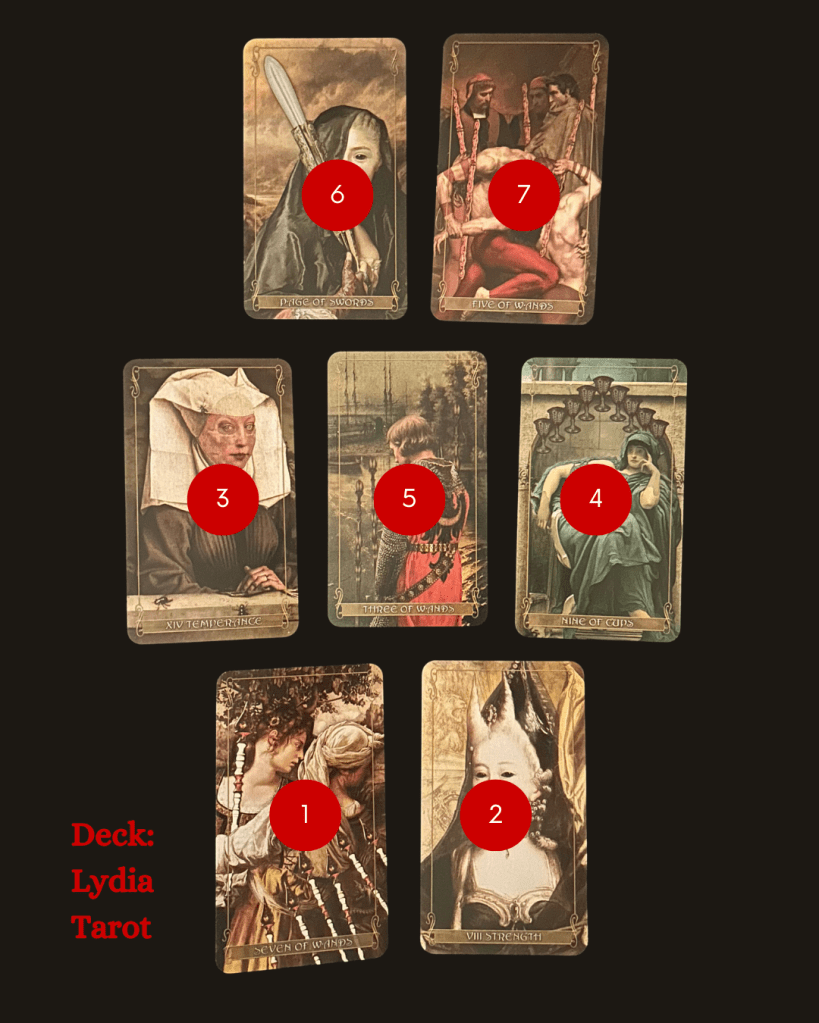

Card 1 – The Mask: What persona do I present to the world? This card represents the carefully constructed self you show others—the acceptable face you’ve learned to wear.
Card 2 – The Repressed: What aspect of myself have I pushed into shadow? This reveals a quality, desire, or capacity you’ve denied or hidden, often because it was deemed unacceptable by your family or culture.
Card 3 – The Gift in the Shadow: What power or strength lies dormant in this rejected part? Every shadow aspect contains energy and potential. This card shows what you gain by integrating rather than suppressing.
Card 4 – The Projection: Where am I seeing my shadow in others? This card illuminates how your unacknowledged traits manifest as strong reactions to other people—the qualities you judge harshly in others are often the ones you refuse to see in yourself.
Card 5 – The Fear: What am I afraid will happen if I embrace this part of myself? This card reveals the underlying terror that keeps you from integration—fear of rejection, loss of control, or becoming someone you’ve been taught to despise.
Card 6 – The Integration Practice: How can I consciously work with this shadow aspect? This card offers practical guidance for bringing this energy into your life in healthy, constructive ways.
Card 7 – The Wholeness: What becomes possible when I accept my monstrosity? This final card shows the potential that emerges when you stop fragmenting yourself—the creativity, authenticity, and power that comes from embracing your full humanity.
Lay the cards in a circle, with Cards 6-7 as the crown, reminding us that wholeness is the destination of this journey. Take your time with each card, journaling about the images, symbols, and feelings that arise. The monsters you meet here are not your enemies—they are the exiled parts of yourself, waiting to come home.


 Sibyl's Lab of Cartomantics
Leave a comment