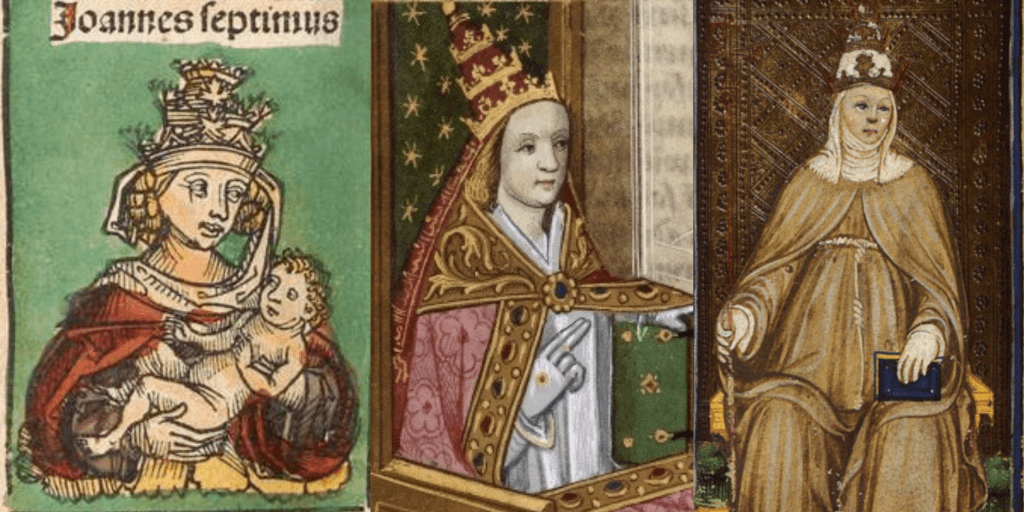
The High Priestess card in modern tarot decks carries an air of ancient wisdom and feminine mystery, but her origins trace back to one of the most controversial figures in medieval Christianity: the legendary Pope Joan, or “La Papessa” as she was known in Renaissance Italy. This enigmatic card has undergone centuries of transformation, evolving from a scandalous political statement into a symbol of intuitive knowledge and hidden wisdom.
The Medieval Legend That Started It All
The story of Pope Joan first emerged in the 13th century, telling of a brilliant woman who disguised herself as a man to pursue education and eventually rose through the ranks of the Catholic Church to become Pope. According to the most widely circulated version of the legend, she was born in Mainz around 822 CE and showed exceptional intellectual prowess from a young age. Determined to receive an education that was forbidden to women of her time, she adopted male clothing and identity, eventually making her way to Athens and later to Rome, where her theological knowledge and scholarly abilities impressed church officials.
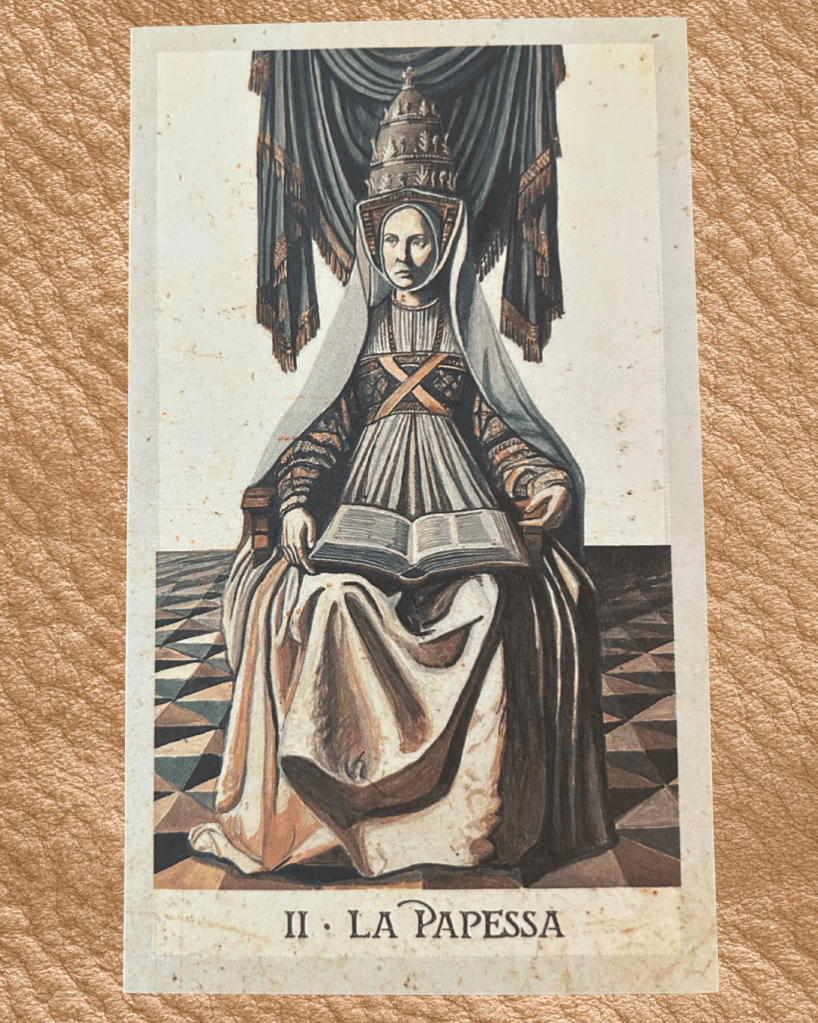
According to legend, she ruled as Pope John VIII from 855 to 857 CE, successfully maintaining her disguise through careful behavior and perhaps the assistance of trusted allies within the Vatican. Her reign was reportedly marked by wise governance and theological insight, with no one suspecting her true identity. However, her secret was dramatically revealed when she gave birth during a papal procession between the Lateran Palace and St. Peter’s Basilica, causing scandal and outrage among the faithful who witnessed this unprecedented event. (Left: Matronua Tarot)
While historians have largely debunked this tale as medieval folklore with no contemporary documentation or archaeological evidence to support it, the legend persisted and evolved throughout the centuries. It captured the imagination of Renaissance Europe, appearing in chronicles, artwork, and popular literature as both a cautionary tale about deception and a symbol of female intellectual capability. Most significantly for occult traditions, this powerful archetype found its way into the earliest tarot decks, where Pope Joan became immortalized as the High Priestess card, representing hidden knowledge, intuition, and the divine feminine.
From Scandal to Symbolism
When tarot cards first appeared in 15th-century Italy, they were not the mystical tools we know today but rather a sophisticated card game for the nobility and wealthy merchant classes. These elaborate decks served as both entertainment and status symbols, featuring intricate hand-painted artwork that showcased the patron’s wealth and cultural refinement. The inclusion of “La Papessa” (The High Priestess) alongside “Il Papa” (The Pope) in these early decks was likely a bold and provocative political statement, reflecting the growing anti-clerical sentiment and religious tensions that were simmering throughout Renaissance Italy.

The Visconti-Sforza deck (see left), one of the earliest surviving tarot sets commissioned by the powerful Milanese families around 1450, depicts the Papess as a regal woman wearing papal vestments and a triple crown, directly challenging the male-dominated hierarchy of the Catholic Church. This imagery was particularly audacious given the Church’s absolute authority at the time, and some scholars believe it may have referenced the legendary Pope Joan, a mythical female pope who supposedly ruled in the 9th century. The card’s presence in aristocratic circles suggests that even among the elite, there was a willingness to question and subtly mock ecclesiastical power through the seemingly innocent medium of a card game.
The Transformation Through Time
As tarot evolved from a parlor game into a tool for divination, the Papess underwent a remarkable transformation. By the 18th century, occultists began reinterpreting the card’s meaning, moving away from its controversial origins toward more esoteric symbolism. The figure became associated with hidden knowledge, intuition, and the divine feminine principle that balances the masculine authority of the Hierophant (formerly The Pope).
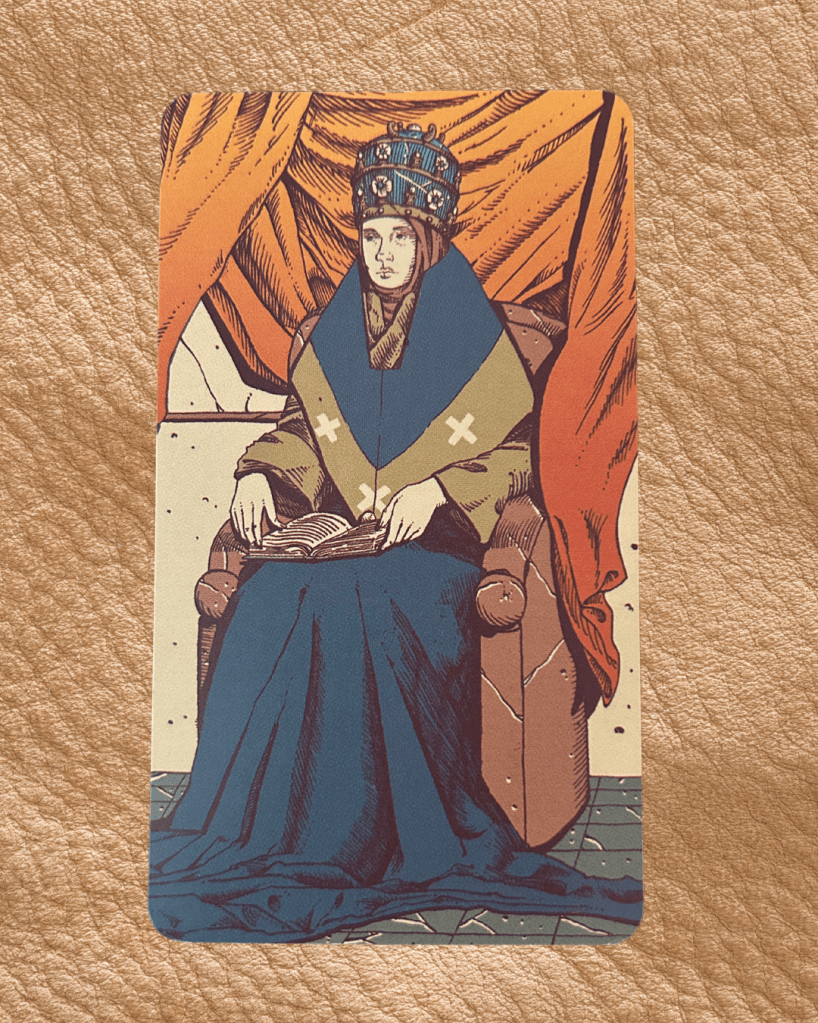
Today’s High Priestess bears little resemblance to the medieval Pope Joan, yet she retains the essence of forbidden knowledge and feminine power that made the original Papess so compelling. Seated between pillars of duality, holding the scroll of hidden wisdom, she represents the gateway between the conscious and unconscious minds. Her evolution from a figure of medieval scandal to a symbol of spiritual insight reflects humanity’s changing relationship with both religious authority and feminine wisdom. (Left: Nouveau Tarot de Marseille, edges trimmed)
The journey of the Tarot Papess reminds us that symbols are living things, constantly evolving to meet the spiritual and psychological needs of each generation. What began as a provocative challenge to papal authority has become one of tarot’s most profound archetypes, embodying the eternal human quest for hidden truth and inner knowing.
The Papess Wisdom Spread: A Five-Card Layout for Hidden Knowledge
This spread honors the High Priestess’s role as guardian of mysteries and intuitive wisdom. Arrange the cards in the shape of a crescent moon, reflecting her lunar associations and the cyclical nature of hidden knowledge revealing itself.
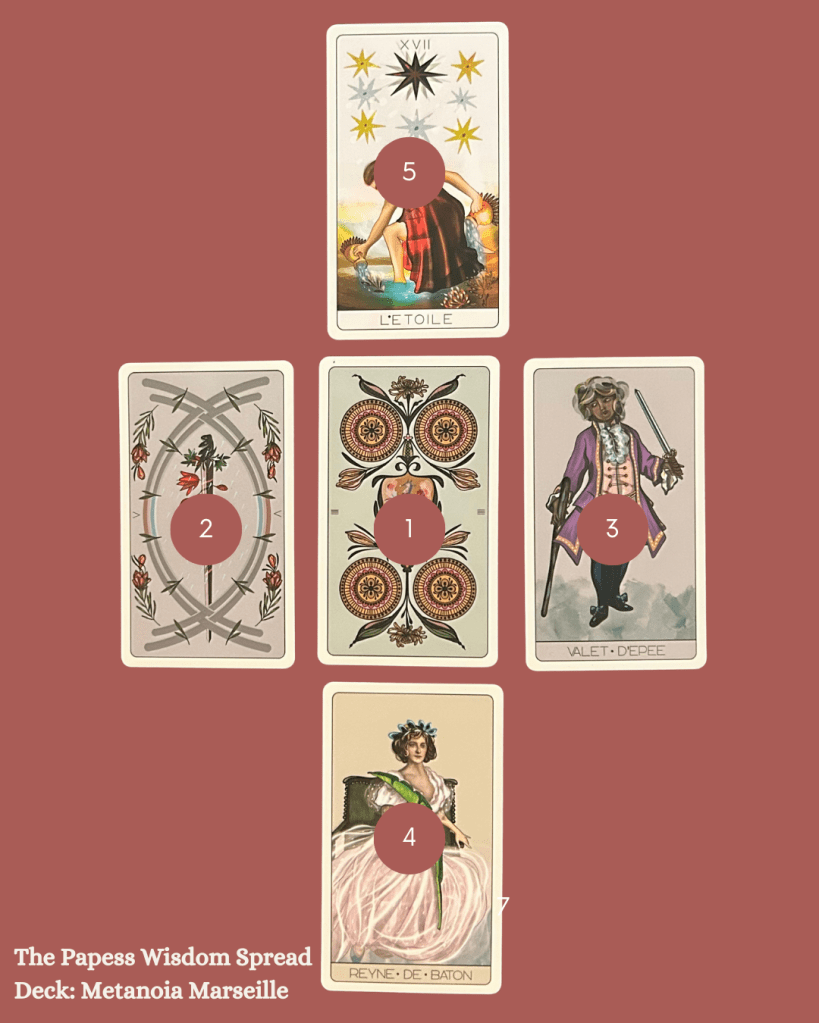
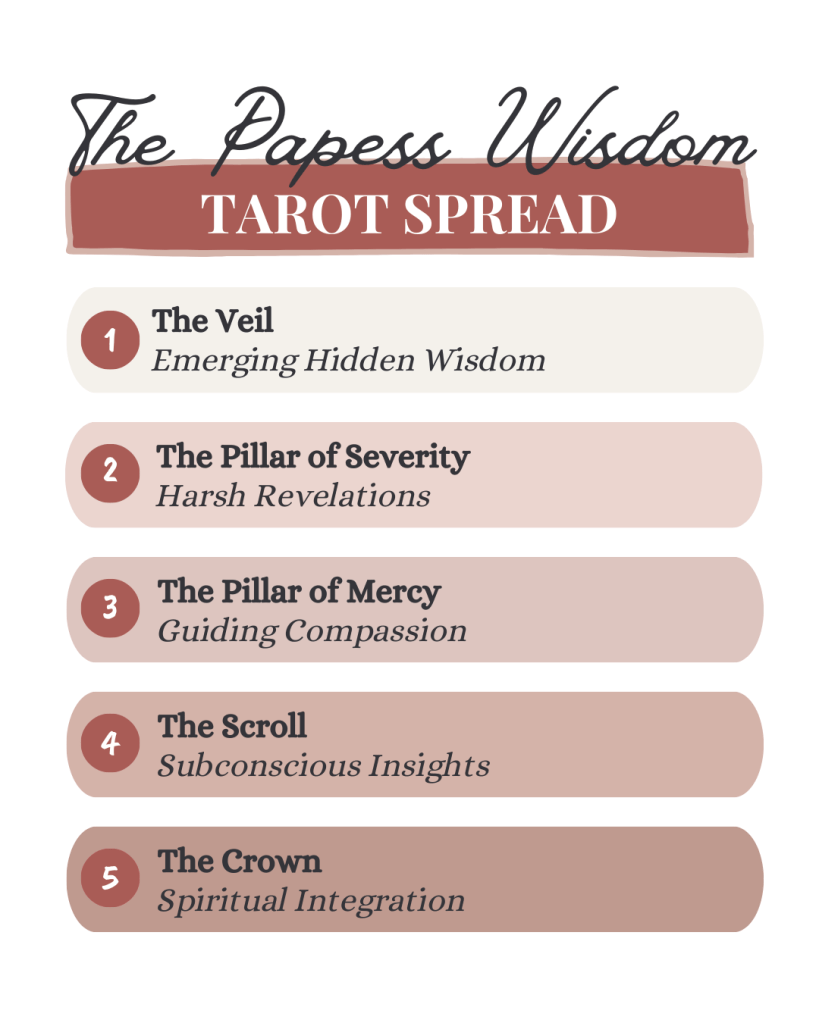
Card Positions:
- The Veil (center): What hidden knowledge is ready to be revealed to you now?
- The Pillar of Severity (left): What harsh truths must you acknowledge to move forward?
- The Pillar of Mercy (right): What compassionate understanding will guide your path?
- The Scroll (bottom center): What wisdom from your subconscious mind needs to surface?
- The Crown (top): How can you integrate this knowledge into your conscious awareness?
Reading the Spread:
Begin with The Veil card to understand the central mystery at hand. Move to the Pillars to explore the balance between difficult truths and gentle guidance. The Scroll reveals deeper, often overlooked insights from your inner wisdom, while The Crown shows how to practically apply these revelations in your daily life.
This spread works particularly well during the new moon or when facing decisions that require you to trust your intuition over external advice. Like the Papess herself, it encourages you to look beyond surface appearances and trust the knowledge that comes from within.

 Sibyl's Lab of Cartomantics
Leave a comment