
Sibyl here, eager to set the mood. My mouthy handmaidens, Danielle and Amelia, are presently crafting a (virtual) cabinet of curiosities, offering consultants a cross-section of readings to book at their leisure. But first, a story: When one of my acolytes (I’ll spare her the indignity of naming her) had the temerity to ask the most basic questions—What is a cabinet of curiosities? And what does it have to do with divination?—I had to take a breath. Somebody clearly didn’t do the reading. But alas, after some light shaming to calm my temper, I settled on answering in writing. It’s hard to find good help these days and it’s simply easier to cover the basics myself.
Consider this post my summary answer to the aforementioned inquiries, offered here should you also need a refresher on European cultural idiosyncrasies. After a few millennia, I’ve learned to expect the best but prepare for the worst. So join me on an imaginative journey through the history of European oddity acquisition. More specifically, let’s travel to the royal domain of a 16th-century emperor.
Enter the dimly lit chamber of Rudolf II’s Kunstkammer in Prague castle, containing wonders that defy categorization. Narwhal tusks masquerading as unicorn horns, crystalline formations caught light like frozen star-fire, and mechanical automata moving with an almost supernatural grace. Yet among these marvels, something more profound is taking place than mere collection or display. The Holy Roman Emperor’s cabinet of curiosities has become a tool for reading the future, a three-dimensional oracle that transformed objects into omens and artifacts into answers.
The relationship between cabinets of curiosities and divination practices represents one of the most fascinating intersections of Renaissance knowledge-seeking and mystical tradition. These collections, which flourished from the 16th through 18th centuries, were far more than early museums or displays of wealth and learning. They functioned as sophisticated instruments for understanding the hidden connections between all things, serving as both repositories of wonder and mechanisms for glimpsing divine will through material objects.
The Philosophical Foundation of Wonder
To understand how cabinets of curiosities evolved into divinatory tools, we must first grasp the worldview that created them. The Renaissance mind operated under a fundamentally different understanding of reality than our modern scientific perspective. The concept of correspondences dominated intellectual life, suggesting that everything in the universe was connected through invisible threads of sympathy and influence. This hermetic philosophy, derived from ancient texts attributed to Hermes Trismegistus, proposed that the microcosm reflected the macrocosm, that earthly objects contained celestial influences, and that careful study of material things could reveal spiritual truths.
Within this framework, collecting became a form of natural philosophy. Each object in a cabinet of curiosities was not merely a specimen but a node in an vast network of meaning. A piece of coral might represent the element of water, the planet Venus, and the human circulatory system simultaneously. A lodestone could embody magnetic attraction, divine love, and the pull of destiny. When assembled together in a single space, these objects created what scholars have termed a “theater of the world,” a compressed universe where all knowledge could be accessed and all questions potentially answered.
The very act of collecting was understood as a form of divination in itself. Collectors believed that they were guided by providence or fate in their acquisitions. The appearance of a particular object at a particular moment was never considered coincidental but rather a sign that needed interpretation. This belief transformed the cabinet from a passive repository into an active oracle, where the arrangement and juxtaposition of objects could reveal hidden truths about past, present, and future.
The Architecture of Revelation
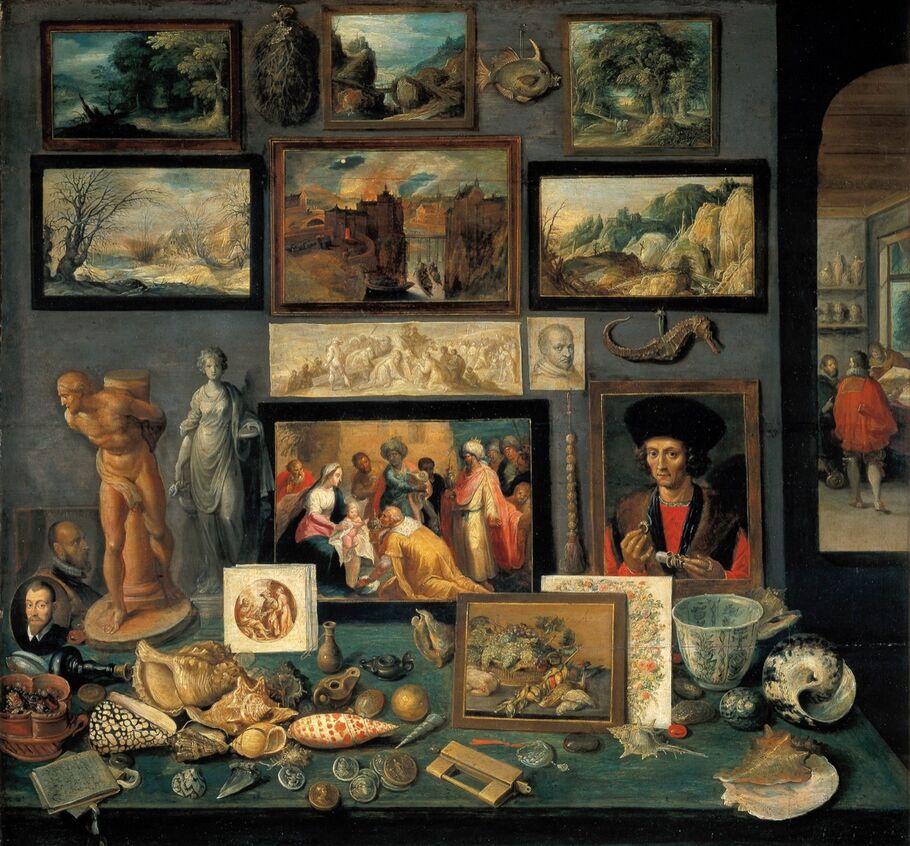
The physical organization of cabinets of curiosities reflected their divinatory function. These were not random accumulations but carefully orchestrated spaces designed to facilitate revelation. The most sophisticated cabinets were arranged according to complex symbolic systems that drew from astrology, alchemy, natural magic, and Christian mysticism. Objects were grouped not only by their material properties but by their occult correspondences, creating a kind of three-dimensional mandala that could be read like a sacred text.
The famous cabinet of Ferrante Imperato in Naples, documented in detailed engravings from the late 16th century, exemplifies this approach. Suspended from the ceiling were creatures of the air, while terrestrial specimens occupied the walls and aquatic forms were displayed in vessels below. This arrangement mirrored the cosmic hierarchy of the four elements, creating a space where the visitor could literally walk through the structure of creation. Such organization was not merely aesthetic but functional, allowing the cabinet’s owner to perform what we might call “spatial divination,” reading meaning from the relationships between objects in different zones of the collection.
The most elaborate cabinets included specialized furniture designed to enhance their oracular function. Rotating display cases allowed objects to be brought into new relationships with one another, creating fresh combinations for interpretation. Hidden compartments and secret drawers added an element of chance to the revelation process, as the opening of a particular drawer at a particular moment might be seen as divinely guided. Some cabinets incorporated actual divination tools such as astrolabes, armillary spheres, and scrying mirrors, blurring the line between scientific instrument and magical apparatus.
The lighting of these spaces was also carefully considered. Many cabinets were designed to be viewed by candlelight or oil lamp, creating an atmosphere of mystery and transformation. The flickering illumination would cause objects to appear and disappear from view, shift in color and texture, and cast shadows that might themselves be read as omens. This interplay of light and darkness transformed the cabinet into a kind of camera obscura of the soul, where hidden truths could be projected onto the walls of consciousness.
Objects as Oracles
Within the cabinet of curiosities, individual objects functioned as specialized divination tools, each with its own symbolic vocabulary and interpretive tradition. Natural specimens were particularly prized for their oracular potential, as they were believed to contain the direct imprint of divine creativity. Fossils, for instance, were often interpreted as “nature’s medals,” commemorating significant events in cosmic history. Their discovery and placement in a collection was seen as a form of temporal divination, allowing the collector to read the deep history of the earth and perhaps glimpse its future transformations.
Crystals and minerals occupied a special place in the divinatory hierarchy of cabinet objects. Their geometric perfection was understood as a manifestation of divine mathematics, while their optical properties made them natural scrying tools. Rock crystal spheres were used for crystal gazing, but even rough specimens were believed to concentrate and focus spiritual energies. The color, clarity, and internal inclusions of crystals were all subject to interpretation, creating a complex system of mineral divination that paralleled the more familiar practices of astrology and palmistry.
Exotic specimens from distant lands carried particular divinatory weight, as they were seen as messages from unknown realms of creation. The arrival of a new specimen from the Americas or Asia was often interpreted as a portent of political or spiritual significance. The famous “vegetable lamb” specimens that appeared in European cabinets, actually cotton plants from Central Asia, were read as signs of the approaching union of plant and animal kingdoms that would herald the end times. Similarly, the appearance of new species of birds or insects was often correlated with contemporary events, creating a kind of natural newspaper written in the language of divine providence.
Artificial objects in cabinets of curiosities also served divinatory functions, particularly those that demonstrated human mastery over natural forces. Mechanical automata were especially significant, as their lifelike movements suggested the possibility of animating matter through spiritual means. The famous mechanical monk created for Philip II of Spain, which could walk, move its arms, and open its mouth in prayer, was not merely a technological marvel but a meditation on the relationship between soul and body, spirit and matter. Such objects served as three-dimensional koans, prompting contemplation of fundamental metaphysical questions.
The Collector as Oracle
The relationship between cabinet of curiosities and divination was mediated by the figure of the collector, who served simultaneously as curator, interpreter, and oracle. These individuals occupied a unique position in Renaissance society, combining the roles of natural philosopher, magician, and spiritual advisor. Their expertise in reading the symbolic language of objects made them sought-after consultants for questions ranging from personal relationships to affairs of state.
The most successful collector-oracles developed reputations that extended far beyond their immediate circles. John Dee, the famous Elizabethan mathematician and magician, maintained an extensive collection of natural and artificial curiosities at his home in Mortlake, which served as both laboratory and oracle chamber. Visitors from across Europe came to consult both Dee and his collection, seeking guidance on everything from alchemical processes to political strategy. Dee’s ability to read meaning from the juxtaposition of objects in his collection was considered one of his most valuable skills, complementing his more famous work with crystal balls and angelic communications.
The collector’s role as oracle was not merely interpretive but actively creative. Through the arrangement and rearrangement of objects, the collector could influence the types of revelations that emerged from consultations. This gave the collector considerable power over the divinatory process, allowing them to guide inquirers toward particular conclusions while maintaining the appearance of objective interpretation. The most skilled practitioners learned to read their clients as carefully as they read their collections, tailoring their arrangements and interpretations to provide the guidance that would be most beneficial.
The social position of collector-oracles was often precarious, as their activities straddled the boundary between legitimate natural philosophy and suspect magical practice. While some enjoyed the patronage of powerful nobles or monarchs, others faced persecution from religious authorities who viewed their practices as potentially heretical. This tension added an element of danger to the practice of cabinet divination, making it both more exclusive and more potent in the eyes of its practitioners.
Bonus: The Cabinet of Curiosities Tarot Spread
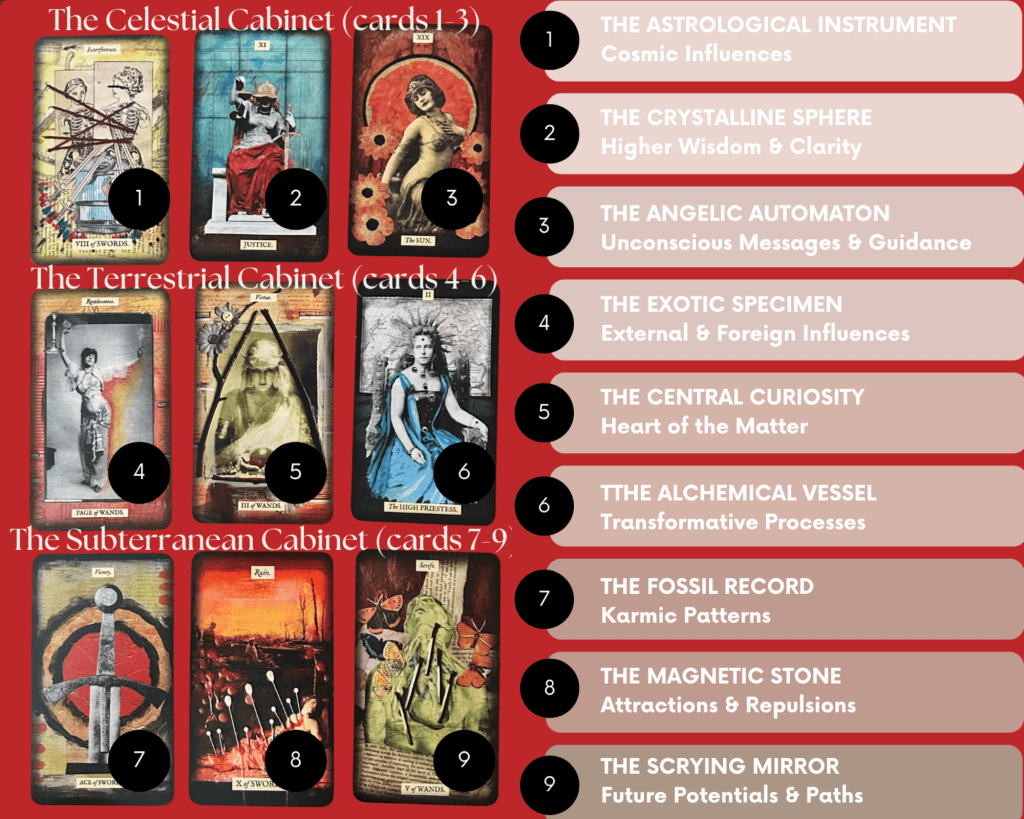
Sibyl here, with an invitation—in the form of a tarot to spread—to do some exclusive, potent fortunetelling of your own. The Cabinet of Curiosities Spread mirrors the organizational principles and symbolic logic of these Renaissance collections. Framed as a three-dimensional exploration of consciousness, each of the nine card positions represent a different “chamber” or “display case” within the querent’s personal cabinet of experience.
A pause for practicalities, if you don’t mind. As a crone, I rarely have patience for the superfluous woo-woo faffery that too often gets in the way of scratched-up-table, crouching-in-the-dirt fortunetelling. But for you, cabinet-loving tarotist, I make this exception. For the sake of ambiance and to enhance the connection with historical cabinet practices, I recommend setting a mood of your own, with the sacred space and reverent approach of a true Renaissance collector. Arrange some assemblage of odd and meaningful objects, candles, or crystals that create an atmosphere of wonder and contemplation. Done yet? If so, it’s time to consult the tarot’s cabinet.
The Nine-Chamber Layout
This spread arranges nine cards in a 3×3 grid, representing the different categories and levels of a Renaissance cabinet. Each position corresponds to a specific aspect of the querent’s situation, creating a comprehensive map of both visible circumstances and hidden influences.
Upper Row: The Celestial Cabinet (Spiritual Influences)
- Position 1 – The Astronomical Instrument: Divine guidance and cosmic influences affecting the situation
- Position 2 – The Crystalline Sphere: Higher wisdom and spiritual clarity available to the inquirer
- Position 3 – The Angelic Automaton: Messages from the unconscious and synchronistic guidance
Middle Row: The Terrestrial Cabinet (Material Reality)
- Position 4 – The Exotic Specimen: External circumstances and foreign influences entering your life
- Position 5 – The Central Curiosity: The heart of the matter; the most significant element requiring attention
- Position 6 – The Alchemical Vessel: Transformation and change processes currently active
Lower Row: The Subterranean Cabinet (Hidden Forces)
- Position 7 – The Fossil Record: Past influences and karmic patterns affecting the present
- Position 8 – The Magnetic Stone: Attractions and repulsions; what draws you forward or holds you back
- Position 9 – The Scrying Mirror: Future potentials and the path ahead
The reading begins with the Central Curiosity (Position 5), which sets the tone for the entire consultation. From there, the reader explores the vertical columns as interconnected systems: Column 1 represents the foundation and structure of the situation, Column 2 reveals the core dynamics and transformative potential, and Column 3 illuminates the communication and guidance aspects.
Special attention should be paid to any cards that seem to “speak” to each other across the grid, creating what cabinet collectors would have recognized as chains of correspondence. Fortunetellers are encouraged to look for correspondences across the three levels, noting how celestial influences manifest in terrestrial reality and how hidden forces shape visible circumstances.

 Sibyl's Lab of Cartomantics
Leave a comment