
Once upon a time, Sibyl met the Madman masquerading as the Holy Fool masquerading as the Wanderer masquerading as the Innocent, and she suggested we track his steps across a multiplicity of decks, if we truly want to understand the tarot.
The Fool—arcana zero in the Major Arcana sequence—embodies perhaps the most profound conceptual transformation within tarot’s esoteric tradition. While maintaining its position as the unnumbered catalyst of the journey through the trumps, this multivalent archetype has evolved from medieval Le Mat to Pamela Colman Smith’s cliff-edging youth to today’s diverse representations. This evolution reflects not merely artistic preference but deeper currents in esoteric philosophy, cultural politics, and the democratization of mystical traditions.
From Le Mat to Spiritual Initiate
In the surviving Visconti-Sforza decks and their contemporaries, the Fool (or Le Mat in the Tarot de Marseille tradition) manifests as the excluded figure—the one card unnumbered and outside the formal hierarchy of trumps. This positioning reflects the card’s liminal status within both cartomantic structures and social hierarchies. The iconography—tattered garments, wanderer’s staff—connected the Fool to the medieval archetype of the Holy Fool and the broader Hermetic concept of the initiate who appears foolish to the uninitiated.
With the occult revival of the late 19th century, the Golden Dawn’s reinterpretation fundamentally altered the Fool’s esoteric significance. Aleister Crowley’s assignment of the Hebrew letter Aleph (א) and the elemental force of Air to the Fool positioned it as the primordial breath, the beginning of manifestation itself. The Rider-Waite-Smith (RWS) revision maintained these associations while softening the imagery toward the neophyte stepping into the mysteries—connecting the card to the broader Neoplatonic concept of the soul’s descent into matter.

Beyond Traditional Symbolism
Advanced practitioners recognize that the Fool’s iconography contains multiple symbolic layers beyond casual interpretation. In decks like the Wild Unknown Tarot, the precipice represents not just physical danger but the threshold between formal reality (Binah) and formless potential (Kether)—a metaphor particularly resonant in climate discourse where material consequences intersect with abstract potentiality. Similarly, the companion animal has evolved from Levi’s interpretation as base instinct to symbolize the higher self’s guide, exemplified in The Brady Tarot where native species replace the European lapdog. Esoteric interpretations like those in The Alchemical Tarot have also transformed the bundle and staff, recasting them as the four elements in potential form—tools of manifestation rather than simple possessions, reflecting contemporary spiritual frameworks.
Perhaps most significant is how independent publishing has transformed access to advanced tarot knowledge. Historical texts once guarded within closed magical lodges now inform diverse creator perspectives. The Fool in Jessica Dore’s Tarot for Change or the Dust II Onyx Tarot becomes not merely a figure of innocence but a deliberate challenger to entrenched systems—bridging Western esoteric traditions with anti-colonial and liberation frameworks. Such decks position the Fool’s Journey as inherently political—the zero that precedes the one represents potential outside established hierarchies. This interpretation aligns with both postcolonial critique and the card’s traditional position outside formal trumps.
Concluding at Zero: A Portal to the Present
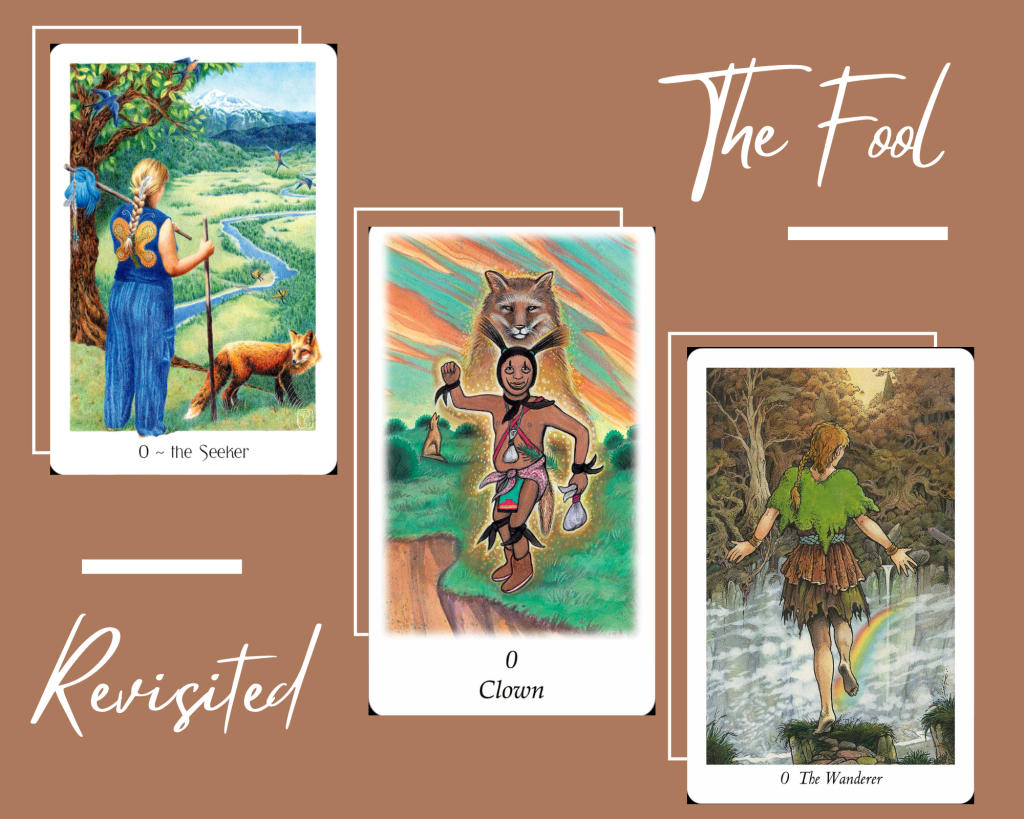
For the initiated reader, the Fool represents not merely new beginnings but the initiatory paradox itself: the simultaneous embodiment of supreme wisdom and complete innocence. The card’s evolution across traditions demonstrates how esoteric symbolism adapts to cultural context while maintaining core metaphysical significance. In contemporary practice, the Fool continues to serve as the point of liminality between manifest and unmanifest reality—the eternal moment of crossing thresholds. How various traditions depict this crossing reveals not only their aesthetic preferences but their fundamental aesthetic and political positions regarding the nature of transformation itself.

 Sibyl's Lab of Cartomantics
Leave a comment